Body Recomp Calorie & Macro Targets by Experience Level (2026)
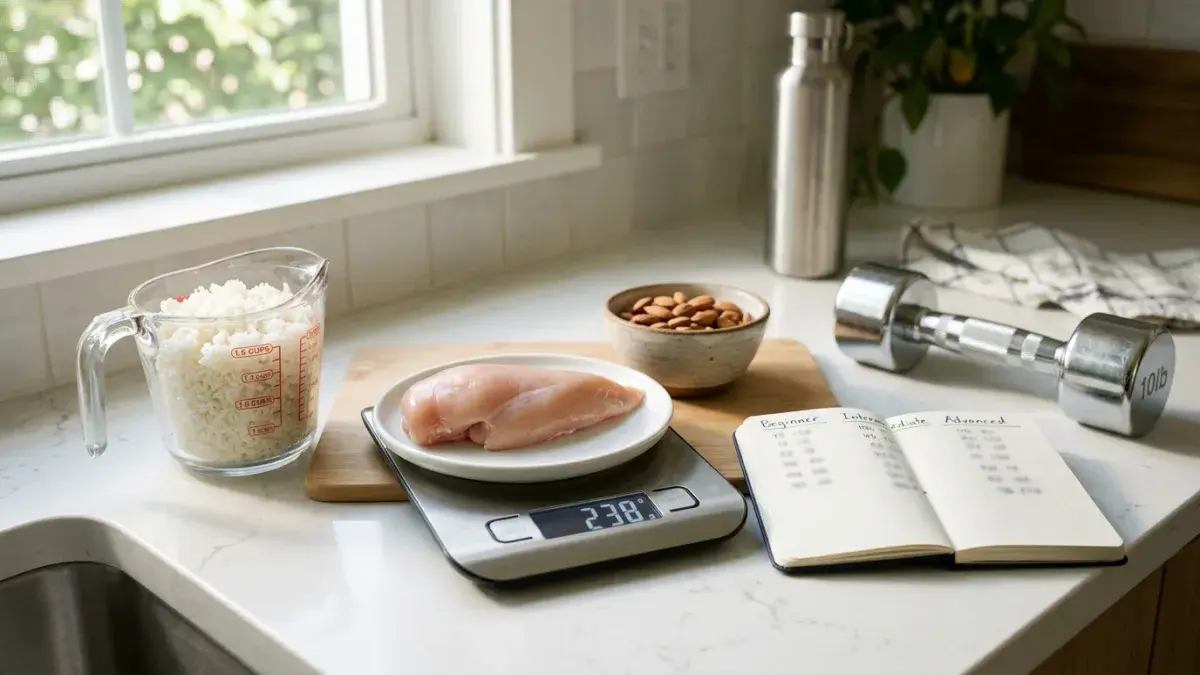
The standard recomp advice — "eat at maintenance, hit your protein, lift heavy" — gets the general direction right and the specific numbers wrong. A beginner with 22% body fat, an intermediate at 16%, and an advanced lifter at 11% need three different calorie targets, three different protein floors, and three different carb-to-fat splits. The same protocol applied to all three produces a mediocre result for everyone. This guide gives the actual targets, by experience level, with worked examples and the studies behind each number. For a personalized calculation that pulls your weight, body fat, and activity into a single set of numbers, the body recomposition calculator is the one-screen answer.
What "Experience Level" Means for Recomp
Experience level in this article is not about gym membership length — it is about the combination of training age, body-fat starting point, and how close the lifter is to their natural ceiling. The three operational definitions:
- Beginner: Under 12 months of consistent resistance training, body fat 18-28% (men) or 25-35% (women), still adding weight to the barbell almost every session. The body responds to almost any reasonable stimulus and tolerates a meaningful calorie deficit while still building muscle.
- Intermediate: 1-3 years of consistent training, body fat 13-18% (men) or 20-26% (women), linear progression has stalled and weekly progress has become block-based. The body responds to specific stimuli and is less forgiving of a deficit.
- Advanced: 3+ years of consistent training, body fat under 13% (men) or under 22% (women), within 80% of natural strength and hypertrophy ceiling. Recomp at this level is functionally a slow lean bulk with strict body-fat enforcement.
The body-fat criterion matters as much as the training-age criterion. A 22%-body-fat lifter with 4 years of training experience is operationally a beginner for recomp purposes, because the high body-fat starting point gives them the metabolic room to build muscle in a deficit that an 11%-body-fat lifter does not have. The classic Helms, Aragon & Fitschen review (PMID 24092765) and the follow-up Iraki et al. review on off-season natural bodybuilding (PMID 31247944) both make this distinction explicitly.
Calorie Targets by Experience Level
The recomp deficit shrinks as the lifter gets leaner and more experienced. The reason is biomechanical and metabolic: at higher body fat, the body can pull energy from stored fat to fund muscle protein synthesis. At lower body fat, the body resists further fat oxidation, raises hunger, and slows recovery — a deficit that worked at 22% body fat will cause active muscle loss at 11%.
| Experience | Body fat (M / F) | Calorie target | Deficit vs TDEE |
|---|---|---|---|
| Beginner | 18-28% / 25-35% | TDEE - 300 to -500 kcal | 15-20% |
| Intermediate | 13-18% / 20-26% | TDEE - 100 to -250 kcal | 5-10% |
| Advanced | <13% / <22% | TDEE +0 to +100 kcal | Maintenance to +3% |
The TDEE input matters here — if your starting estimate is wrong, every downstream number is wrong with it. Calibrate your TDEE for two weeks with measured intake and bodyweight change before locking in the recomp targets. The walkthrough in how to calculate TDEE covers the calibration procedure, or run the numbers through the body recomp calculator and refine from there.
Protein Targets by Experience Level
Protein is the most leveraged variable in a recomp protocol — both because the right intake protects lean mass during the deficit and because protein has the highest thermic effect of food (~25-30% of ingested calories burned in digestion, vs ~6-8% for carbs and ~2-3% for fat). The intake target rises slightly with experience, not because the muscle needs more grams per se but because the lean-mass-protective effect matters more as the body-fat starting point drops.
| Experience | Protein floor | Per-kg basis | For a 75 kg lifter (15% BF) |
|---|---|---|---|
| Beginner | 1.8-2.2 g/kg bodyweight | Total bodyweight | 135-165 g |
| Intermediate | 2.2-2.6 g/kg lean mass | Lean body mass | 140-166 g |
| Advanced | 2.4-3.0 g/kg lean mass | Lean body mass | 153-191 g |
The Murphy & Koehler 2022 systematic review on protein intake during energy restriction (PMID 34550066) consolidates the evidence that 1.6-2.4 g per kg bodyweight is the operative range for lean-mass retention, with the upper end of the range favored when the deficit is larger or the lifter is leaner. The Helms 2014 review pushed the intermediate-and-advanced floor higher (to 2.3-3.1 g per kg of fat-free mass) for natural physique athletes specifically — the population closest to the advanced recomper. The recomp protein guide covers the distribution-across-meals question (4-5 doses of 30-50 g) that the per-day total alone does not address.
Carbs vs Fat: The Programming Decision
After calorie and protein targets are locked, the remaining calories are split between carbs and fat. The default split that holds across all three experience levels is: fat at the lower bound of the safe-hormone range, carbs taking the rest. The Iraki 2019 review explicitly recommended 20-30% of calories from fat for off-season natural bodybuilders, with 0.5-1.5 g per kg as the operative range. Going below 0.5 g/kg risks hormonal disruption — testosterone, in particular, drops measurably below this floor in men.
| Macro | Beginner (75 kg) | Intermediate (75 kg) | Advanced (75 kg) |
|---|---|---|---|
| Calories | 2,300 kcal | 2,650 kcal | 2,850 kcal |
| Protein | 150 g (26%) | 160 g (24%) | 175 g (25%) |
| Fat | 65 g (25%) | 70 g (24%) | 72 g (23%) |
| Carbs | 280 g (49%) | 340 g (52%) | 375 g (52%) |
Carbs above 3 g/kg consistently outperform low-carb approaches for lifters trying to retain or build muscle, primarily because muscle glycogen drives training intensity. A depleted glycogen state at the start of a hypertrophy session reduces total work output by 8-15%, which compounds across a 12-week block into a real hypertrophy gap. For the broader macro-split logic, the macro calculator and the deep-dive in cutting vs bulking macros 2026 cover the body-of-evidence in detail.
Worked Examples
Beginner: 85 kg male, 24% body fat, moderately active
TDEE: ~2,800 kcal (Mifflin-St Jeor BMR of 1,810 kcal x 1.55 activity). Recomp target: 2,400-2,500 kcal (deficit of 300-400 kcal, ~15%). Protein: 170 g (2.0 g per kg bodyweight). Fat: 75 g (0.9 g per kg). Carbs: 285 g (the remaining 1,140 kcal). The deficit is large enough to deliver visible fat loss in 8-12 weeks while the protein and training stimulus drive muscle gain. The BMR derivation behind this is unpacked in the BMR formula explainer.
Intermediate: 75 kg female, 22% body fat, active
TDEE: ~2,200 kcal. Recomp target: 2,050-2,100 kcal (5-7% deficit). Lean mass: 58.5 kg. Protein: 140 g (2.4 g per kg lean mass). Fat: 60 g (0.8 g per kg bodyweight). Carbs: 245 g. The smaller deficit reflects the leaner starting point. Hitting protein at the upper bound is non-negotiable here — undereating protein at this body-fat level is the most common cause of stalled-recomp complaints in the intermediate population.
Advanced: 90 kg male, 11% body fat, very active
TDEE: ~3,400 kcal. Recomp target: 3,400-3,500 kcal (maintenance to slight surplus). Lean mass: 80 kg. Protein: 200 g (2.5 g per kg lean mass). Fat: 90 g (1.0 g per kg bodyweight). Carbs: 425 g. The "recomp" at this level is operationally a slow lean bulk — fat loss is no longer the primary lever; lean mass gain at a slight surplus while holding body fat below 13% is the actual protocol. Plug the numbers into the body recomp calculator to see how the targets shift if body fat drifts to 12.5% or 13.5%.
Common Mistakes by Experience Level
Beginner: under-eating protein, over-eating "healthy" calories
The beginner archetype hits 1.2-1.4 g/kg protein and over-eats calorie-dense "clean" foods — nuts, nut butters, oils, avocado. The net result is a non-deficit at a too-low protein intake, which produces neither fat loss nor meaningful muscle gain. The fix is mechanical: weigh fats, hit 1.8+ g/kg protein from primarily lean sources, and trust the small deficit to do the work.
Intermediate: overtraining and under-recovering
Intermediates typically nail nutrition and break recovery. Five or six training days per week at moderate intensity produces less hypertrophy than three or four days at high intensity with adequate recovery. The recomp training split guide covers the volume-vs-intensity tradeoff in detail. Body fat plateauing in week 6-8 of an intermediate recomp is almost always a recovery problem, not a calorie problem.
Advanced: ignoring body-fat creep
Advanced recompers operating in a slight surplus often let body fat drift up to 14-15% over the course of 6 months before noticing. The discipline of a strict body-fat ceiling (re-measure every 4 weeks; if body fat exceeds 13%, drop calories by 150-200 until it returns to 11-12%) is what separates the advanced recomp protocol from a slow undisciplined bulk.
The Tracking Cadence
For the first 6-8 weeks of any recomp protocol, daily macro tracking is non-negotiable. Recomp tolerances are tight: a 100-kcal daily error and a 20-g daily protein shortfall compound into a real composition difference by week 8. After 6-8 weeks of measured intake, most lifters can transition to free-tracking with a weekly check-in (Sunday night: log the last 3 days of eating, sanity-check the protein floor). The transition from daily tracking to free tracking is the most fragile point in the protocol — most recomp failures happen here, not in the first month.
Bodyweight: daily, first thing in the morning, fasted, post-bathroom. Take the 7-day rolling average; ignore day-to-day moves. Body fat: every 4 weeks via the same method (skinfolds, smart scale, or DEXA — consistency of method matters more than absolute accuracy). Photos: every 2 weeks (see the before-and-after photos timeline). Waist circumference: every 2 weeks at the navel. For the broader body-fat-by-age and sex context that anchors the body-fat targets above, see the body fat percentage by age and sex review.
Budgeting the Recomp Grocery Bill
A protein-forward recomp diet costs roughly 20-30% more than the average grocery bill — 150-200 g of protein per day means 4-6 servings of chicken, fish, eggs, dairy, or whey. For lifters running tight household budgets, the easiest pre-commitment is to allocate the recomp grocery line in advance and confirm the monthly food spend works against take-home pay. The paycheck calculator at PayScale Pro is the quickest way to back-solve a sustainable monthly food budget against your actual take-home rather than gross salary.
The cheapest per-gram protein sources in 2026: store-brand whey isolate, frozen chicken breast in bulk, large-pack eggs, plain Greek yogurt at warehouse-club pricing, and canned tuna. The most expensive: prepared rotisserie chicken, individual yogurt cups, protein bars, and any "high-protein" branded snack. Shifting the protein sourcing from the second list to the first list typically cuts the recomp grocery bill by 30-40% with no protein-target compromise.
The Bottom Line
Body recomp calorie and macro targets shift with experience level because the underlying physiology shifts. Beginners can run a 15-20% deficit and still build muscle. Intermediates need a 5-10% deficit and a 2.2-2.6 g/kg lean-mass protein floor. Advanced lifters operate at maintenance or a slight surplus with strict body-fat enforcement. Carbs sit at 3-5 g/kg across all three levels; fat sits at the lower bound of the safe-hormone range. Tracking is daily for the first 6-8 weeks, then weekly. The PMIDs — Helms 2014, Iraki 2019, Murphy 2022 — converge on the same operational ranges, even if the precise numbers vary by review.
The fastest way to convert these ranges into your specific targets is the body recomp calculator: enter weight, body fat, activity level, and experience, and the tool returns a single set of daily numbers calibrated for your starting point. From there, the training side (recomp training split), the protein distribution (protein intake guide), and the supplement layer (creatine loading vs maintenance) round out the protocol. Set the numbers, hold them for 8 weeks, then re-measure.
Frequently Asked Questions
Get Your Recomp Macro Targets
Plug your weight, body fat, activity, and experience into the CalcFit body recomp calculator for personalized calorie and macro targets.