Body Recomp Protein Intake: 2.2 g/kg Lean Mass and Why (2026)
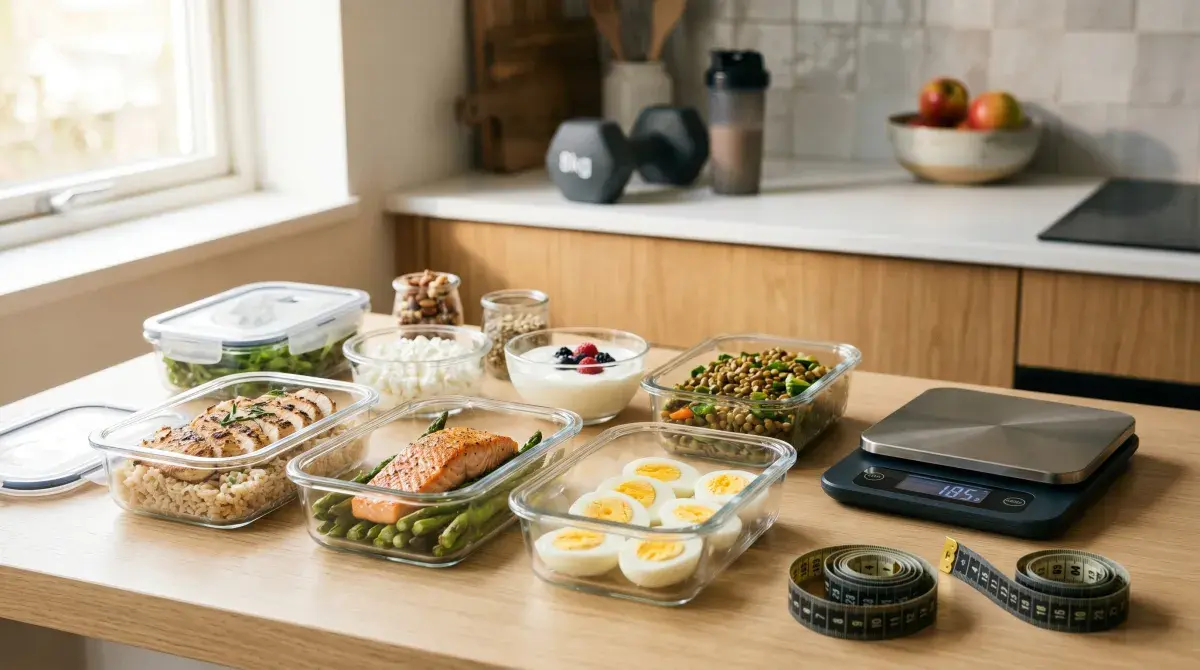
Body recomposition — losing fat and gaining muscle at the same time — is the trickiest physiological tightrope in lifting. You are asking your body to be simultaneously in a calorie deficit (to lose fat) and in a positive nitrogen balance (to build muscle). The lever that makes both possible at once is protein. Get the protein target wrong and you either lose muscle alongside the fat, or you stall hypertrophy because your tissue-repair budget is too thin.
This article gives you the exact daily protein target backed by the most recent meta-analyses, the per-meal distribution that maximizes muscle protein synthesis, and worked examples for lifters from 60 kg to 100 kg. Plug your own numbers into the body recomposition calculator for personalized macros, or read on for the methodology.
The Target Number: 2.2-2.6 g per kg of Lean Mass
The evidence-based protein band for body recomposition is 2.2 to 2.6 grams per kilogram of lean body mass per day. If you do not know your lean mass, the corresponding total-bodyweight range is roughly 1.6 to 2.0 g/kg. Both numbers come from converging research:
- Helms, Aragon & Fitschen 2014 (Journal of the International Society of Sports Nutrition, PMID 24092765): natural lifters in a calorie deficit retained the most lean mass at 2.3-3.1 g/kg of lean body mass.
- Jäger et al. 2017 ISSN Position Stand (PMID 28642676): hypertrophy and lean-mass retention plateau between 1.6 and 2.2 g/kg of bodyweight.
- Morton et al. 2018 meta-analysis (British Journal of Sports Medicine, PMID 28698222): no additional resistance-training-induced hypertrophy above 1.62 g/kg of bodyweight.
The reason the recomp range pushes to the upper end of these recommendations is that you are running a calorie deficit simultaneously. In a deficit, your body raises gluconeogenesis (turning amino acids into glucose), so some of your dietary protein gets diverted away from muscle protein synthesis. Eating at the upper end of the band keeps enough amino acids in the muscle-synthesis pool to support hypertrophy even when your overall calories are below maintenance.
Worked Examples by Bodyweight
These examples assume you have a body fat estimate (from a DEXA, BodPod, or skinfold) and want the precise lean-mass-based number. The conversion is: lean_mass_kg = weight_kg × (1 − body_fat_fraction), then multiply by 2.2-2.6.
| Weight | Body Fat | Lean Mass | Daily Protein (2.4 g/kg lean) | Per Meal (4 meals) |
|---|---|---|---|---|
| 60 kg (132 lb) | 22% | 46.8 kg | 112 g | 28 g |
| 70 kg (154 lb) | 18% | 57.4 kg | 138 g | 34 g |
| 80 kg (176 lb) | 15% | 68.0 kg | 163 g | 41 g |
| 90 kg (198 lb) | 20% | 72.0 kg | 173 g | 43 g |
| 100 kg (220 lb) | 22% | 78.0 kg | 187 g | 47 g |
Notice that a heavier, leaner lifter (90 kg @ 12% would be 79 kg lean → 190 g) eats more protein than a lighter, fatter lifter (90 kg @ 30% would be 63 kg lean → 151 g). The lean-mass-based calculation matters most for athletes at the body-composition extremes. For lifters in the middle (60-80 kg, 15-22% body fat), the simpler 1.8-2.0 g/kg total bodyweight rule lands within 5% of the lean-mass calculation.
Per-Meal Distribution: 30-45 g, Four to Five Meals
Total daily protein matters most, but the per-meal distribution moves muscle protein synthesis (MPS) measurably. Schoenfeld & Aragon (2018) reviewed the MPS dose-response data and concluded that 0.4 g/kg of bodyweight per meal — distributed across at least four eating occasions — produces the highest 24-hour integrated MPS rate.
- 3 meals per day: works but suboptimal; each meal needs 45-55 g protein to hit the daily target, which often exceeds the per-feeding MPS ceiling.
- 4 meals per day: the practical sweet spot for most lifters. 30-45 g per meal, 3-4 hours apart.
- 5 meals per day: useful for lifters above 90 kg or those targeting 180+ g daily. Adds one mid-morning or evening protein feeding.
- 6+ meals per day: no additional MPS benefit. Adds logistical complexity without payoff.
The peri-workout window — 1-2 hours before and 1-2 hours after resistance training — is the only timing constraint that consistently shows up in the literature. Both pre- and post-training meals should contain 25-40 g of leucine-rich protein. Outside that window, even spacing across the day matters more than precision.
Leucine and Protein Quality
Not all protein hits MPS equally hard. Leucine — one of the three branched-chain amino acids — is the primary trigger for muscle protein synthesis. The leucine threshold per meal is roughly 2.5-3.0 grams, which corresponds to:
- 25-30 g of whey protein (~10% leucine by weight)
- 120-150 g of cooked chicken breast or beef
- 4 large whole eggs (~24 g protein, 2.0 g leucine — slightly under, pair with another source)
- 200-250 g of Greek yogurt or cottage cheese
- 40-50 g of pea or soy protein isolate (lower leucine % than whey)
Plant-protein meals usually need an extra 5-10 g of total protein to hit the leucine threshold. This is why our 7-day body recomp diet plan bumps the target for vegan and vegetarian lifters to the upper end of the 2.2-2.6 g/kg lean range.
What Counts as Protein (and What Doesn't)
Track only complete protein sources for your daily target. Specifically:
- Counts fully: chicken, turkey, beef, pork, fish (salmon, tuna, cod, tilapia), eggs, dairy (milk, Greek yogurt, cottage cheese, cheese), whey/casein/egg-white protein powder.
- Counts fully (plant complete): soy (tofu, tempeh, edamame, soy protein isolate), seitan (wheat gluten — leucine sufficient, lower in lysine but adequate in a mixed diet), quinoa.
- Counts partially: beans, lentils, chickpeas, peas, oats. Include them but pair with a complementary protein in the same meal (legume + rice, hummus + pita) or add a scoop of pea/whey to hit the leucine threshold.
- Does not count toward your target: peanut butter (too fat-dominant; track for total calories, not protein quota), broccoli/spinach trace protein (yes, technically protein, but the absorption and amino acid profile are inadequate to count toward MPS).
Common Mistakes
1. Counting Total-Diet Protein, Not Animal-Source Protein
A 200 g chicken breast (46 g) + 1 cup cooked rice (5 g) + 1 cup broccoli (3 g) is not a 54 g protein meal for MPS purposes — it is a 46-49 g protein meal, with the rice and broccoli protein being incomplete and trace respectively. Most apps (MyFitnessPal, Cronometer) sum everything, which inflates your effective number. For recomp, mentally discount trace plant-source protein by 40-50% unless you are specifically eating complementary protein pairs.
2. Skipping the Pre-Sleep Feeding
30-40 g of casein protein (cottage cheese, Greek yogurt, casein shake) 30-60 minutes before bed slows gastric emptying and feeds amino acids into the muscle pool for 6-8 hours overnight. Res et al. 2012 showed pre-sleep casein increased overnight muscle protein synthesis by 22% in resistance-trained men. This is the highest-leverage single meal in a recomp diet.
3. Pushing Protein Above 3.0 g/kg
The upper boundary at 2.6-2.8 g/kg of lean mass is real. Above that, your body increases amino acid oxidation (burning protein for energy) rather than synthesis. You waste expensive protein and crowd out carbs that fuel training intensity. The 4.4 g/kg Antonio et al. 2015 study found no harm but also no benefit — and the food cost was 60-70% higher than the control group's standard intake.
How to Track Without Going Insane
Three practical options, in order of precision:
- Weigh and log every meal for 2 weeks. Use a digital food scale + MyFitnessPal or Cronometer. Get your baseline. After 2 weeks, you will know what a 35 g portion of chicken, salmon, or yogurt looks like by eye, and you can transition to estimation.
- Hand-portion method. One palm-sized serving of meat/fish ≈ 25-30 g protein for women, 35-40 g for men. Four palms per day for a 70 kg female, five for an 80 kg male. Less precise but workable.
- Anchor meals. Build three or four template meals you eat repeatedly (e.g., breakfast = 4 eggs + 200 g Greek yogurt = 40 g; lunch = 200 g chicken + rice + veg = 47 g). Calculate once, eat the same meals 80% of the time, and you will hit your number without tracking.
Protein in Context: It's Not Standalone
Protein intake is the foundational lever for recomp, but it works only inside a complete plan. The other inputs:
- Calorie deficit: 10-15% below maintenance. Calculate yours with the TDEE calculator.
- Resistance training: 3-5 sessions per week, 10-20 hard sets per muscle group per week, progressive overload. See our progressive overload guide.
- Carbohydrates: 3-5 g/kg bodyweight on training days, 2-3 g/kg on rest days, to fuel training intensity and recovery.
- Fats: 0.8-1.0 g/kg bodyweight minimum for hormonal health (the cutting floor; do not drop below).
- Sleep: 7-9 hours. Sleep loss disproportionately damages lean mass during a deficit.
The body recomp calculator takes all five of these inputs and produces your weekly macros. For the timeline question — “how fast will I actually recomp?” — see the body recomp math piece. For women-specific guidance, the female recomp protocol covers cycle-phase adjustments and the slightly different protein math for menstruating athletes.
The Bottom Line
Hit 2.2-2.6 g per kg of lean body mass per day, distributed across 4-5 meals of 30-45 g each, with one of those meals being a casein-rich pre-sleep feeding. Track for two weeks to build intuition, then estimate. Use whole-food protein sources for 70-80% of the target and a whey or plant-protein scoop for the remainder. Do not push above 2.8 g/kg lean — the protein dollar buys nothing extra past that point, and you sacrifice the carbs that fuel hard training.
Get the protein right and your recomp becomes a deterministic process driven by training and a moderate calorie deficit. Get it wrong and the deficit eats your muscle. The number is small. The leverage is enormous. And if you're sorting out the take-home cash side of optimizing your training time (so you can hit four 60-minute sessions per week without your day job killing the schedule), the freelance rate calculator at PayScale Pro handles the income-side math for the training-time tradeoff.
Frequently Asked Questions
Calculate Your Recomp Macros
Plug your weight, body fat, and activity into the CalcFit body recomp calculator for personalized protein, carb, and fat targets.