Body Fat Percentage by Age and Sex: 2026 Evidence Review (DEXA-Validated)
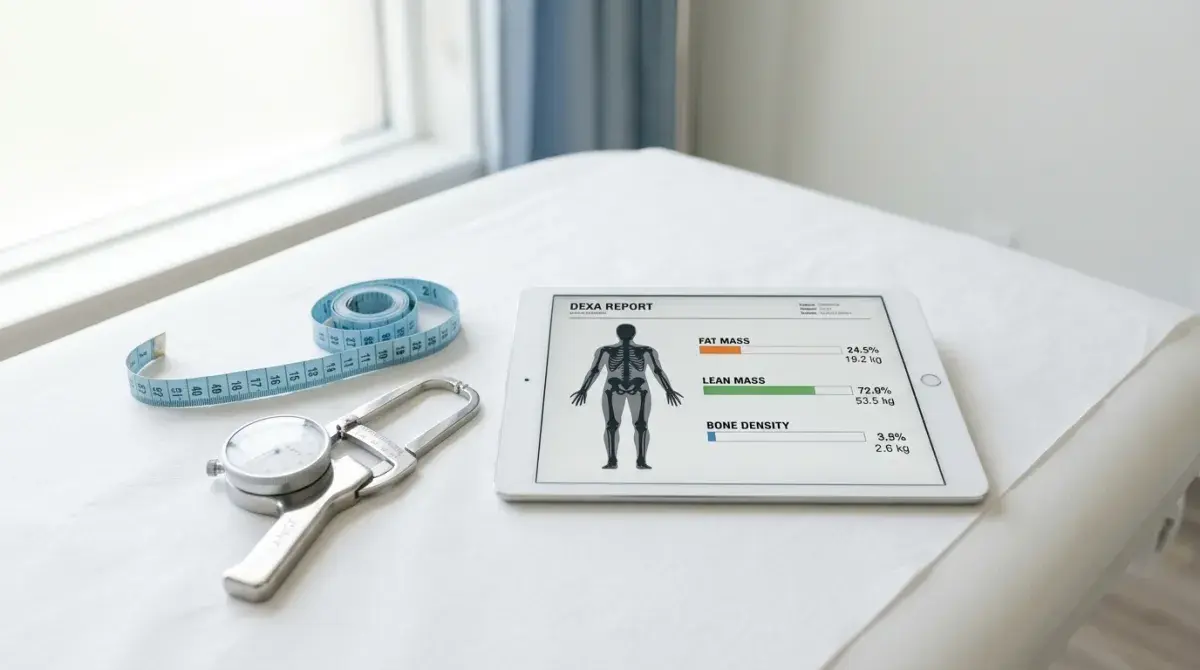
The body fat percentage charts that dominate the first page of Google in 2026 are almost all rebrands of the same 1980s American Council on Exercise (ACE) reference table, sometimes mixed with the older Lange caliper norms. Most of them omit the underlying dataset, the measurement method, and the age stratification — and most omit the published DEXA-validated revisions of the last fifteen years. This is an evidence review of where the reference ranges actually come from, what NHANES and ACSM say in 2026, how accurate the measurement methods are against the gold standard, and what a realistic monthly rate of fat loss looks like for someone who wants to actually move from one bracket to the next.
Two sources do most of the lifting in the modern literature: the National Health and Nutrition Examination Survey (NHANES) DEXA dataset, which contains body composition scans on ~20,000 US adults stratified by age, sex, and ethnicity, and the periodically updated position statements from the American College of Sports Medicine (ACSM) and the International Society for the Advancement of Kinanthropometry (ISAK). Every defensible body fat reference range in 2026 traces back to one or both of these. The Heo et al. 2012 percentile analysis of the NHANES DEXA cohort (PMID 22301929) is the single most widely cited source for age- and sex-stratified ranges in the current literature.
DEXA-Validated Reference Ranges: Men
The following ranges are derived from the NHANES DEXA percentile distribution and aligned with the ACE classification thresholds. They represent the 25th-75th percentile band ("healthy") rather than population averages, which sit higher due to the prevalence of overweight and obesity in the underlying NHANES cohort.
| Age (men) | Essential | Athletic | Healthy | Above Avg | Obese |
|---|---|---|---|---|---|
| 20-39 | 3-5% | 6-10% | 11-21% | 22-27% | ≥28% |
| 40-59 | 3-5% | 7-11% | 12-22% | 23-28% | ≥29% |
| 60-79 | 3-5% | 8-13% | 13-25% | 26-30% | ≥31% |
The healthy band drifts upward with age because lean mass declines (sarcopenia) at roughly 0.5-1.0% per year after age 30 per Mitchell et al. 2012 (PMID 22934149). At stable body weight, lost muscle is replaced by fat on a near-1:1 basis, raising the body fat percentage. A 50-year-old man at 18% body fat is in the same "fitness bracket" as a 25-year-old man at 13-15%, after adjusting for the expected lean mass trajectory. To compute your own target weight at a chosen body fat percentage, the body fat calculator handles the conversion from current measurements.
DEXA-Validated Reference Ranges: Women
Women carry a higher essential fat floor — roughly 10-13% versus 3-5% in men — due to sex-linked reproductive and endocrine fat depots. The same NHANES-derived ranges, stratified by age:
| Age (women) | Essential | Athletic | Healthy | Above Avg | Obese |
|---|---|---|---|---|---|
| 20-39 | 10-13% | 14-20% | 21-33% | 34-39% | ≥40% |
| 40-59 | 10-13% | 15-21% | 23-34% | 35-40% | ≥41% |
| 60-79 | 10-13% | 16-22% | 24-36% | 37-42% | ≥43% |
The female essential fat floor is non-negotiable. Sustained body fat below 14% in women is associated with menstrual dysfunction, bone density loss, and the full RED-S syndrome described by Mountjoy et al. 2018 (PMID 29773536). Female physique competitors who drop below 12% for show day return to ~17-20% within weeks because the body actively defends the reproductive fat depot. Treat the 14% threshold as a hard floor, not a target.
Why Age Matters: Sarcopenia and the Lean Mass Trajectory
The single most important reason body fat reference ranges are age-stratified is the predictable decline in lean mass after age 30. The longitudinal data from Mitchell et al. 2012 (PMID 22934149) documents an average loss of 0.5-1.0% of lean mass per year between 30 and 60, accelerating to 1.0-1.5% per year after 60. For a 75 kg adult with 55 kg of lean mass at age 30, that's a loss of 8-15 kg of lean tissue by age 60 if no resistance training intervention is applied.
At stable body weight, that lost muscle is replaced by adipose tissue, raising body fat percentage by 10-20 percentage points across the adult lifespan in a sedentary population. This is the trajectory the reference ranges adjust for — and the trajectory resistance training meaningfully blunts. The Peterson et al. 2011 meta-analysis (PMID 21472338) demonstrates that resistance training in older adults produces 1.1 kg of lean mass gain on average over 18-20 weeks, effectively reversing 1-2 years of expected sarcopenia. For the calorie target that supports lean mass maintenance during a fat loss phase, the BMR calculator gives the baseline metabolic rate from which the deficit should be calculated.
Body Fat Percentage vs BMI: What the Literature Says
BMI was designed as a population-level screening tool. It performs poorly at the individual level for body composition assessment because it cannot distinguish muscle from fat. The NHANES analysis by Romero-Corral et al. 2008 (PMID 18283284) demonstrated that roughly 50% of adults with normal BMI (18.5-24.9) had elevated body fat percentage — a phenotype the authors labeled "normal-weight obesity" — and these individuals carried cardiometabolic risk profiles comparable to BMI-defined obese individuals.
The reverse misclassification is also common: muscular adults with BMI in the overweight or obese range often have low body fat percentages and low cardiometabolic risk. The practical implication is that BMI alone is insufficient for individual health decisions. A defensible 2026 framework combines BMI for fast screening, body fat percentage for body composition assessment, and waist circumference (men <94 cm low risk, ≥102 cm high risk; women <80 cm low risk, ≥88 cm high risk per the WHO thresholds) as a proxy for visceral adipose tissue.
Measurement Accuracy: What Actually Works
Reference ranges are only useful if you can measure yourself accurately against them. The methods rank predictably by accuracy and cost.
| Method | Error vs DEXA | Cost | Best For |
|---|---|---|---|
| DEXA scan | ± 1-2 pp (gold standard) | $40-150 | Quarterly absolute calibration |
| Bod Pod (ADP) | ± 2-3 pp | $50-90 | Sports performance centers |
| Skinfold (7-site Jackson-Pollock) | ± 3-4 pp (trained tester) | $30-60 + tester | Lean/athletic populations |
| 8-electrode BIA | ± 3-5 pp | $150-500 | Daily trend tracking at home |
| 4-electrode BIA (foot only) | ± 5-8 pp | $40-120 | Budget trend tracking |
| Navy tape method | ± 4-6 pp | Free | Free home estimate |
The Achamrah et al. 2018 systematic review (PMID 30339880) compared BIA against DEXA across 22 studies and found mean absolute errors of 3-8 percentage points, with the largest deviations at the extremes — lean athletes (BIA underestimates fat) and obese subjects (BIA overestimates fat). The practical implication: do not chase a single BIA reading. Track on the same device, at the same time of day, in the same hydration state, and use the trend over 4-8 weeks rather than the absolute number.
For trend tracking specifically, the body recomposition tracker and the calculation logic in the body recomposition math guide explain how to read changes in body fat percentage against simultaneous changes in lean mass — the two signals that matter when you're trying to lose fat without losing muscle.
Realistic Rates of Body Fat Loss
The published literature converges on a defensible weekly rate of 0.5-1.0% of body weight per week for fat loss with lean mass preservation. The Garthe et al. 2011 RCT (PMID 21558571) randomized elite athletes to slow (0.7%/wk) or fast (1.4%/wk) weight loss. The slow group preserved lean mass and improved strength; the fast group lost lean mass and saw strength stagnate or decline. The Helms et al. 2014 natural bodybuilding review (PMID 24864135) reached the same conclusion across the contest prep literature.
Translated into body fat percentage terms, an evidence-based monthly target is roughly:
- Obese starting point (≥30% men, ≥40% women): 1.5-2.5 pp / month with adequate protein and resistance training
- Overweight (22-30% men, 34-40% women): 1.0-1.5 pp / month
- Healthy range to athletic (15-22% men, 24-34% women): 0.5-1.0 pp / month
- Athletic to lean (10-15% men, 18-24% women): 0.3-0.5 pp / month, with progressively higher risk of lean mass loss
- Lean to essential (5-10% men, 14-18% women): 0.2-0.3 pp / month, with hormonal monitoring recommended
Protein intake is the single most important variable for lean mass preservation during a deficit. The Morton et al. 2018 meta-analysis (PMID 29405780) identified 1.6 g/kg as the threshold below which resistance training adaptations are blunted. For body composition contexts specifically, 2.0-2.4 g/kg of lean body mass is the standard recommendation during a cut per the body recomp protein intake guide. For the daily target, the 7-day body recomp diet plan shows what those numbers look like as actual meals.
Body Fat Distribution Matters More Than the Number
A 30% body fat reading on a man who carries most of that fat viscerally (around the organs) carries roughly 3-5x the cardiometabolic risk of a 30% reading on a man who carries it subcutaneously. The DEXA scan provides this regional breakdown (android vs gynoid fat ratio); BIA scales largely do not. Waist circumference is the cheapest proxy for visceral adipose tissue and tracks closely with DEXA-measured visceral fat in the Romero-Corral analysis (PMID 18283284).
Practical thresholds from the WHO and the American Heart Association: men <94 cm (37 in) is low risk, ≥102 cm (40 in) is high risk; women <80 cm (31.5 in) is low risk, ≥88 cm (35 in) is high risk. A male reader at 22% body fat with a 92 cm waist is in a meaningfully better cardiometabolic position than a male reader at 22% body fat with a 105 cm waist, even though the body fat percentage is identical. For a structured weekly cardiovascular complement that targets the visceral fat depot specifically, the Zone 2 cardio heart rate guide covers the intensity prescription with the deepest evidence base.
Common Misreadings of the Reference Ranges
"Single-digit body fat is the goal." No published health guideline endorses this. Sustained body fat below the essential threshold (3-5% men, 10-13% women) is associated with hormonal disruption, immune compromise, and the RED-S syndrome. Single-digit body fat is a competition prep window measured in days, not a lifestyle target.
"My body fat went up so I gained fat." Body fat percentage is a ratio. If lean mass drops (post-illness, post-injury, post-bed-rest), the percentage rises even if absolute fat mass is unchanged. Always interpret the percentage alongside total weight and an estimate of lean mass change. The lean body mass vs body fat tracking guide walks through the math.
"My BIA scale says 18% and DEXA says 24% — one of them is wrong." Both are operating within their published error bars. The DEXA reading is the more accurate absolute number. The BIA reading is useful for tracking changes over time on the same device. Use DEXA quarterly for calibration and BIA daily for trend.
"Skinny-fat is a myth." The Romero-Corral 2008 NHANES analysis names this phenotype "normal-weight obesity" and demonstrates it carries elevated cardiometabolic risk. It is a published, measurable, clinically relevant phenotype — roughly 30 million US adults — and it is the strongest argument for using body fat percentage and waist circumference in addition to BMI for individual health assessment.
Putting It Together: A Defensible 2026 Framework
Pick the age- and sex-appropriate healthy range from the tables above. Measure body fat percentage with the best method you can afford on the cadence that fits your goal — DEXA quarterly for absolute calibration, BIA or skinfolds weekly or monthly for trend. Track waist circumference in parallel as a visceral fat proxy. Set a monthly fat loss target inside the evidence-based 0.5-1.0% of body weight per week range. Hold protein at 1.6-2.4 g/kg. Resistance train at least 2-3 sessions per week to defend lean mass. If body fat is rising at stable weight, the signal is sarcopenia, not gluttony — the response is more lifting, not more deficit.
For the calculators that operationalize this framework: body fat percentage calculator (Navy tape method estimate), body recomposition planner (simultaneous fat-loss and lean-gain projection), BMR calculator (baseline metabolic rate for deficit calculation), and the salary raise calculator at pay.thicket.sh for budgeting the DEXA-scan cadence into your annual planning. The DEXA literature is unambiguous: when the measurement method is consistent and the reference range is age- and sex-adjusted, body fat percentage is one of the most actionable health metrics in the consumer toolkit.
Frequently Asked Questions
Find Your Current Body Fat Percentage
The CalcFit body fat and body recomp calculators use the Navy tape method and the evidence-based recomposition math from the literature reviewed above.