Macros for Cutting vs Bulking — 2026 Evidence Review
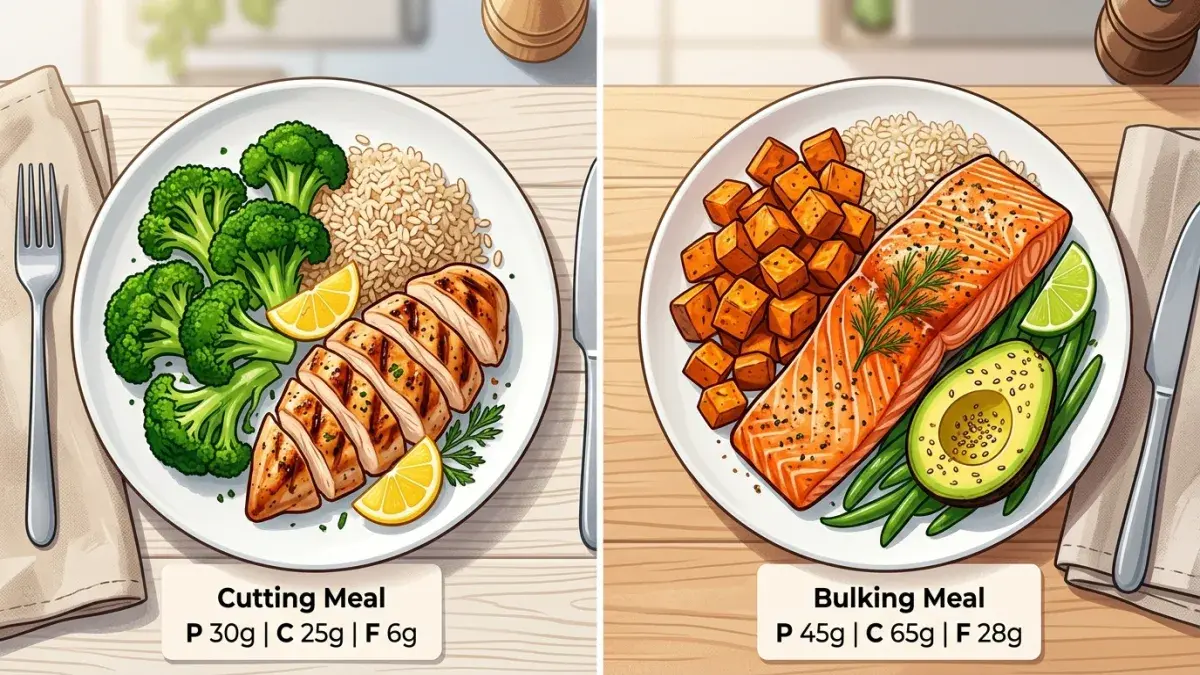
The evidence on macro splits for cutting and bulking has converged substantially over the last decade. The core numbers — protein targets, fat floors, and carbohydrate ranges — are well-established, and most of the remaining debate is about edge cases: aggressive deficits, advanced lifters, and the new GLP-1 pharmacological landscape. This is the 2026 evidence review of what to eat in each phase, drawn from peer-reviewed meta-analyses and position stands.
The Framework: Calories First, Macros Second
Weight change is ultimately dictated by energy balance. Macros determine the quality of that change — how much fat you lose versus muscle, how much of a gain is muscle versus fat — but the calorie target is the primary lever. The practical calorie targets:
- Cut: 10-25% below maintenance TDEE. Faster cuts (25%) preserve less lean mass but finish faster. Use the TDEE calculator to find maintenance.
- Bulk: 5-15% above maintenance TDEE, targeting 0.25-0.5% body weight gain per week (Aragon and Schoenfeld, JISSN 2013, PMID 23679146).
- Recomp (simultaneous fat loss and muscle gain): Maintenance ± 100-200 kcal. Realistic mainly for beginners, returning trainees, and those with higher body fat. See our body recomposition guide.
Protein: The Non-Negotiable Macro
Protein is the one macro where the cutting and bulking numbers diverge meaningfully, and the evidence is clear enough to treat as settled.
Bulking protein target
The 2018 systematic review and meta-analysis by Morton et al. in the British Journal of Sports Medicine (PMID 28698222) analyzed 49 studies (1,863 participants) and concluded that protein intakes above ~1.62 g/kg/day produced no additional gains in fat-free mass from resistance training. The practical bulking range:
Bulk: 1.6-2.2 g/kg of total body weight
Cutting protein target
During calorie deficit, protein requirements rise to protect lean mass. Helms et al.'s 2014 review in the Journal of the International Society of Sports Nutrition (PMID 24864135) recommends:
Cut: 2.3-3.1 g/kg of lean body mass
The shift from total-weight denominator (bulking) to LBM denominator (cutting) makes a real difference for heavier or higher-body-fat individuals. Calculate your LBM with the lean body mass calculator, then dial in protein with the protein calculator.
The Longland et al. 2016 RCT in the American Journal of Clinical Nutrition (PMID 26817506) demonstrated this in practice. 40 young men in a 40% calorie deficit with resistance training gained lean mass on 2.4 g/kg/day protein but lost it on 1.2 g/kg/day — same training, same calorie deficit, very different body composition outcomes.
Fat: The Minimum Floor
Dietary fat is essential for hormone production, vitamin absorption, and cell membrane integrity. The minimum target in any phase:
Fat floor: ~0.6-0.8 g/kg of body weight
Below that, testosterone production in men can drop, as documented by multiple studies including a 1997 review by Volek et al. in the Journal of Applied Physiology. Dropping below ~20% of daily calories from fat is the rough threshold to avoid. In a cut, a reasonable target is 0.8-1.0 g/kg total weight; in a bulk, 0.8-1.2 g/kg is typical. Once protein and fat floors are set, carbohydrates fill the rest of the calorie budget.
Carbs: The Performance Lever
Carbohydrate intake drives training performance and glycogen replenishment. During a cut, lower carbs by necessity (calories are restricted); during a bulk, higher carbs support higher training volumes. The practical ranges, after protein and fat are set:
| Phase | Protein | Fat | Carbs | Typical % Split |
|---|---|---|---|---|
| Aggressive cut (25% deficit) | 2.8-3.1 g/kg LBM | 0.8 g/kg BW | Remainder | 40/30/30 |
| Moderate cut (15% deficit) | 2.3-2.6 g/kg LBM | 1.0 g/kg BW | Remainder | 35/25/40 |
| Maintenance / recomp | 1.8-2.2 g/kg BW | 1.0 g/kg BW | Remainder | 30/25/45 |
| Lean bulk (10% surplus) | 1.6-2.0 g/kg BW | 1.0-1.2 g/kg BW | Remainder | 25/22/53 |
| Aggressive bulk (15% surplus) | 1.6-1.8 g/kg BW | 1.2 g/kg BW | Remainder | 22/23/55 |
Use the macro calculator to plug in your weight and goal — it applies these ranges automatically.
Worked Example: 80 kg Trained Male, Moderate Cut
Consider an 80 kg trained male at 18% body fat (LBM ~65.6 kg) with a maintenance TDEE of 2,800 kcal. Target: 15% deficit = 2,380 kcal.
- Protein: 2.5 g/kg LBM × 65.6 kg = 164 g = 656 kcal
- Fat: 1.0 g/kg BW × 80 kg = 80 g = 720 kcal
- Carbs remaining: 2,380 − 656 − 720 = 1,004 kcal = 251 g
Final split: 164 g protein / 251 g carbs / 80 g fat. Percentages: 28/42/30. Check this against the calorie deficit calculator to see how fast this produces weight loss.
Worked Example: Same Athlete, Lean Bulk
Same 80 kg athlete, now targeting 10% surplus = 3,080 kcal for a lean bulk.
- Protein: 1.8 g/kg BW × 80 kg = 144 g = 576 kcal
- Fat: 1.1 g/kg BW × 80 kg = 88 g = 792 kcal
- Carbs remaining: 3,080 − 576 − 792 = 1,712 kcal = 428 g
Final split: 144 g protein / 428 g carbs / 88 g fat. Percentages: 19/56/25. Note the dramatic shift toward carbohydrates — this is where training fuel comes from.
Timing, Distribution, and Meal Frequency
Macro distribution across the day matters less than once thought. The 2018 Schoenfeld and Aragon meta-analysis in JISSN (PMID 29497353) confirmed a per-meal protein dose of 0.4 g/kg distributed across 3-5 meals maximizes muscle protein synthesis. Beyond that, total daily intake is what drives outcomes. Meal frequency — 3, 4, 5, or 6 meals — does not independently affect body composition when macros and calories are matched (per Schoenfeld's 2015 meta-analysis).
The GLP-1 Era Adjustment
Semaglutide (Ozempic, Wegovy) and tirzepatide (Zepbound, Mounjaro) now shape weight loss for millions. Clinical trial data — summarized in a 2024 analysis of the STEP and SURMOUNT programs — shows that a substantial fraction of GLP-1-induced weight loss is lean mass, particularly in older adults not engaged in resistance training. Prentice et al. noted lean mass loss fractions of 25-40% in some subgroups.
The implications for macros on GLP-1s:
- Hit protein at the high end of the cutting range (2.5-3.1 g/kg LBM) even when appetite is suppressed.
- Plan small, protein-dense meals rather than large portions — satiety peaks early.
- Resistance train 2-4 times per week. This is the single most effective countermeasure to disproportionate lean mass loss.
- Recheck TDEE more often. Rapid weight loss drops TDEE more than the Mifflin-St Jeor equation predicts (see our TDEE formula comparison).
What the Evidence Does Not Support
- Ultra-low-fat cuts. Below 0.5 g/kg of fat in a cut compromises hormone production without a meaningful metabolic advantage.
- Very-high-protein bulks. Protein above 2.2 g/kg during a bulk does not increase muscle gain (Morton et al. 2018) and displaces carbs that would otherwise fuel training.
- Strict carb cycling for recreational lifters. Outside of competition prep, the data do not show consistent benefit (Iraki et al., 2023).
- Fat-only keto bulks. Ketogenic diets underperform moderate-carb diets for strength and hypertrophy in the most controlled comparisons (Vargas-Molina et al., 2020, Nutrients).
Context: Age, Sex, and Life Stage
Older trainees need the upper end of the protein range — the anabolic resistance of aging means more protein is required per meal to drive the same muscle protein synthesis response. Morton's 2018 review noted the effect was particularly pronounced above age 50. Our age calculator at age.thicket.sh is useful for framing age-adjusted expectations around training volume and recovery.
For pregnant and postpartum women, standard macro frameworks do not directly apply; prenatal and lactating nutrition has its own RDAs. See pregnancy.thicket.sh for trimester-specific guidance.
The Bottom Line
For cutting: high protein (2.3-3.1 g/kg LBM), fat floor around 0.8-1.0 g/kg BW, carbs fill remainder. For bulking: moderate protein (1.6-2.2 g/kg BW), fat 0.8-1.2 g/kg BW, carbs fill the larger remainder. The specifics of the split matter; the category boundaries — protein adequate, fat not too low, calories appropriate — matter more than the exact decimal. Pick a plan within the ranges, execute it for 8-12 weeks, and let the scale and tape tell you whether to adjust.
Get your personalized numbers with the macro calculator, protein calculator, and TDEE calculator.
Frequently Asked Questions
Get Your Cutting or Bulking Macros
Enter your stats and goal. We apply the Helms and Morton evidence-based ranges to give you exact protein, carb, and fat targets.