Why Does My Weight Fluctuate So Much Day to Day?
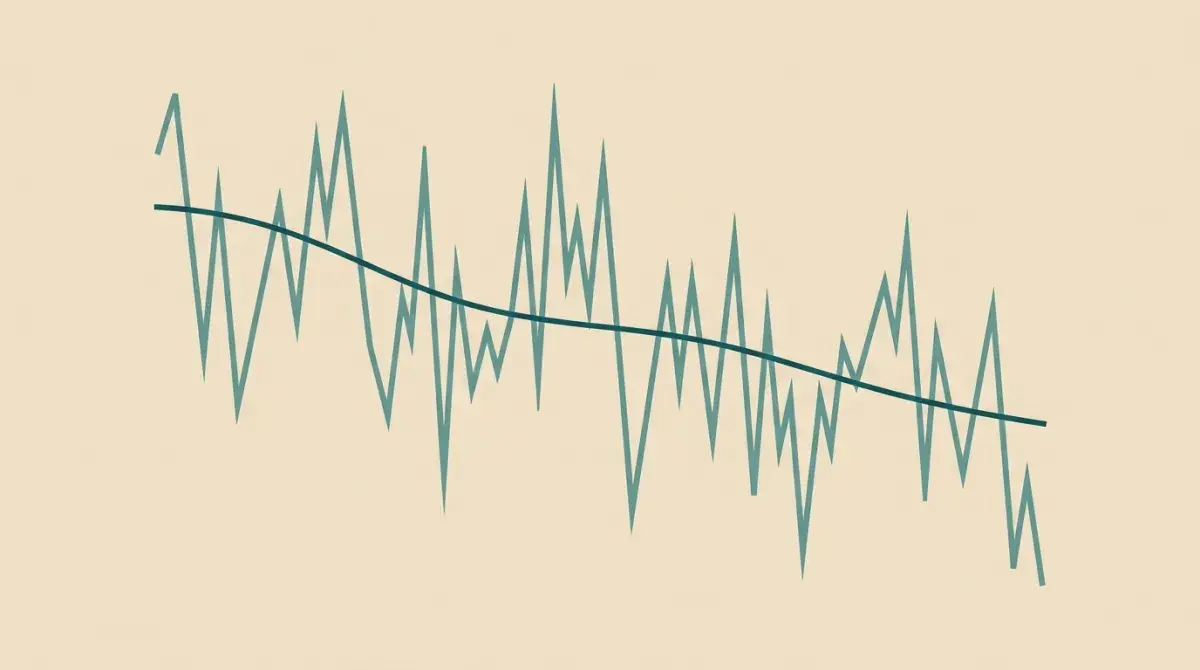
Swings of 1–2 kg (2–4 lb) within a single day are normal, and almost none of it is fat. You can settle that with arithmetic before any physiology: a pound of body fat represents roughly 3,500 calories, so gaining two pounds of actual fat in a day would take about a 7,000-calorie surplus. You did not eat that. Something else moved.
What moved is water, and the contents of your digestive tract.
Glycogen is stored wet, and that is most of it
Your body stores carbohydrate as glycogen, and glycogen does not sit in the muscle dry. A 2015 study in the European Journal of Applied Physiology tested the long-standing 1:3 figure directly, using muscle biopsies during recovery from prolonged exercise. Its conclusion:
“Our findings agree with the long held notion that each gram of glycogen is stored in human muscle with at least 3 g of water.”
In the same study, 150 minutes of cycling in the heat reduced muscle glycogen by 44% and muscle water by 13% — the two move together, in both directions.
The consequence is direct. A few hundred grams of glycogen carries a kilogram or more of water with it. Eat a large carbohydrate meal after a low-carb day and you will weigh more in the morning. Nothing about your body fat changed.
The arithmetic that rules fat out
| Overnight change | If it were fat, you would have needed | Plausible? |
|---|---|---|
| +1 lb | ~3,500 kcal beyond maintenance | Rarely |
| +2 lb | ~7,000 kcal beyond maintenance | No |
| +4 lb | ~14,000 kcal beyond maintenance | Physically not happening |
The 3,500-calorie figure is an approximation rather than a precise constant, but it does not need to be precise to settle this. Whatever the exact number, it is nowhere near small enough to make a four-pound overnight fat gain arithmetically possible.
The other things you are weighing
- Food and drink still inside you. A litre of water weighs a kilogram until you excrete it. You weigh your dinner until it leaves.
- Sodium. Salt shifts how much water your body holds, so a salty meal shows up the next morning and fades over following days.
- Bathroom timing. Straightforward, and larger than people expect.
- Training. Hard or unfamiliar sessions cause temporary fluid shifts in the worked muscle — see does soreness mean growth.
- The menstrual cycle, for those who have one: water retention varies predictably across it, often enough to mask a week of fat loss.
To be straight about the evidence: the glycogen figure above is from a controlled biopsy study. The sodium, gut-content and menstrual-cycle effects are well-established physiology, but the size of each varies enough between people that quoting a single number for them would be false precision.
Why it still fluctuates in a calorie deficit
This is the version that causes the most despair, and the answer is a signal-to-noise problem rather than a metabolic one.
A 500-calorie daily deficit removes roughly 65 grams of fat per day. Your daily water swing is 1,000–2,000 grams. The fat loss is real and it is roughly twenty times smaller than the noise it is hiding inside.
It is not that the deficit stopped working. It is that a bathroom scale cannot resolve 65 grams against that background on any given morning.
What to do instead
- Weigh under identical conditions. Same time, after the bathroom, before eating or drinking, similar clothing. Repeatability matters more than which conditions you choose.
- Judge weekly averages, never single readings. The noise is largely random around the trend; fat change is directional. A seven-day mean cancels most of the water and still tells you something within a week.
- Expect a fast first week and do not believe it. The dramatic early drop on a new diet is mostly glycogen and its water — which is also why it returns the moment you eat normally.
- If daily weighing makes you anxious, weigh weekly. The failure mode to avoid is reacting to one number, in either direction.
Sources
- Fernández-Elías VE, Ortega JF, Nelson RK, Mora-Rodriguez R. “Relationship between muscle water and glycogen recovery after prolonged exercise in the heat in humans.” European Journal of Applied Physiology, 2015;115(9):1919–26. PMID 25911631 — the 1:3 glycogen-to-water ratio, and the 44% / 13% depletion figures.
General information, not medical advice. The cited figures were read from the source on 14 August 2026. Rapid or unexplained weight change — particularly several kilograms held over weeks, or swelling — is worth raising with a doctor rather than a calculator.
Related
- How many calories to lose weight?
- Calories to lose 1 lb per week
- How long does it take to lose muscle?
- Does muscle soreness mean growth?