How Many Calories Should I Eat to Lose Weight?
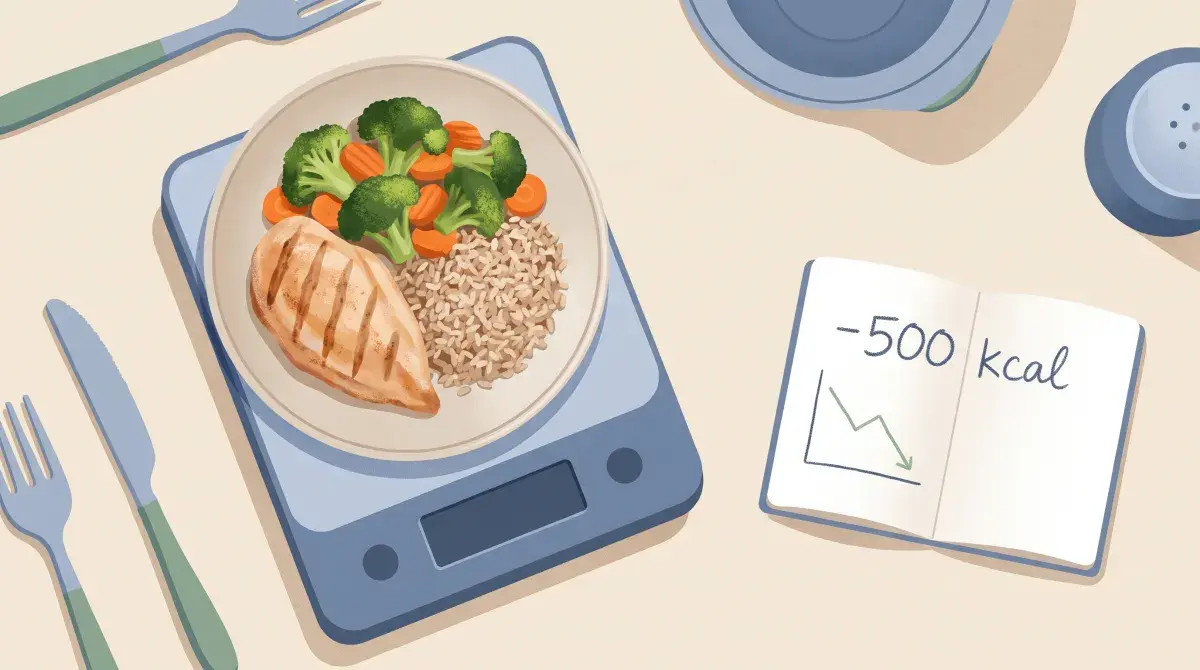
To lose weight, most people eat about 500 calories per day below their Total Daily Energy Expenditure (TDEE), which produces roughly 1 pound of fat loss per week. A 200-pound person who maintains weight at about 2,600 calories would target roughly 2,100 calories per day. The method is always the same two steps: estimate the calories you burn per day, then subtract a deficit. Everything else — the exact deficit, the food choices, the pace — is a refinement of that core equation. Below is how to set your own number, a target table by bodyweight, and why the loss almost always slows before you reach your goal.
Step 1: Find Your Maintenance Calories (TDEE)
Your maintenance level is your TDEE — the total number of calories your body burns in a day, including your resting metabolism plus all movement. You cannot set a sensible deficit without it. The most validated way to estimate TDEE is the Mifflin-St Jeor equation combined with an activity multiplier, and our TDEE calculator does that math for you in a few seconds. If you want to understand the formula itself, the complete guide to calculating TDEE walks through every step and the activity multipliers.
As a rough anchor, a moderately active adult typically maintains at about 14 to 16 calories per pound of bodyweight. A 200-pound moderately active person lands near 2,600 to 3,000 calories per day; a 150-pound person near 2,000 to 2,300. Those are starting estimates only — individual burn varies by hundreds of calories because of non-exercise activity (fidgeting, standing, walking), so treat the first number as a hypothesis to be tested against the scale over two to three weeks.
Step 2: Subtract Your Deficit
The classic guideline is that 1 pound of body fat stores roughly 3,500 calories, so a deficit of 500 calories per day should yield about 1 pound of loss per week, and 1,000 per day about 2 pounds. That is the arithmetic behind the numbers you see everywhere, and it is a reasonable place to start. We break down exactly where the 3,500-calorie rule comes from — and where it breaks down — in how many calories to lose 1 lb per week.
The CDC's healthy-weight guidance recommends a gradual, steady pace of 1 to 2 pounds per week, noting that people who lose weight gradually are more likely to keep it off. A safer, body-size-aware version of the rule used in sports nutrition is 0.5 to 1.0 percent of bodyweight per week: heavier people can lose faster in absolute terms, while lighter people should keep the deficit modest to protect muscle.
| Bodyweight | Est. maintenance (moderately active) | Target for ~1 lb/week (−500) | Target for ~1.5 lb/week (−750) |
|---|---|---|---|
| 130 lb (59 kg) | ~2,000 kcal | ~1,500 kcal | ~1,300 kcal* |
| 150 lb (68 kg) | ~2,200 kcal | ~1,700 kcal | ~1,450 kcal |
| 170 lb (77 kg) | ~2,450 kcal | ~1,950 kcal | ~1,700 kcal |
| 200 lb (91 kg) | ~2,600 kcal | ~2,100 kcal | ~1,850 kcal |
| 230 lb (104 kg) | ~2,950 kcal | ~2,450 kcal | ~2,200 kcal |
| 260 lb (118 kg) | ~3,250 kcal | ~2,750 kcal | ~2,500 kcal |
*Values are estimates for a moderately active adult and round to the nearest 50 kcal. Do not drop below roughly 1,200 kcal/day (women) or 1,500 kcal/day (men) without medical supervision, per the U.S. Dietary Guidelines. Use the TDEE calculator for a figure based on your own age, sex, height, and activity.
Why the 3,500-Calorie Rule Overpromises
The flat "500 calories a day for 1 pound a week, forever" model treats your metabolism as a fixed furnace. It is not. As you lose weight you carry less mass, so you burn fewer calories doing everything — a smaller body needs less fuel. Kevin Hall's dynamic energy-balance model, published in The Lancet in 2011 (PMID 21872751), showed that the 3,500-calorie rule systematically overpredicts long-term weight loss because it ignores this shrinking-burn effect. In reality, a constant calorie intake leads to a new, lower plateau rather than endless linear loss.
The NIH Body Weight Planner (from the National Institute of Diabetes and Digestive and Kidney Diseases) is built on Hall's model and gives a more realistic, personalized calorie target and timeline than the flat rule — it accounts for the fact that maintaining a lower weight requires fewer calories than getting there did.
Adaptive Thermogenesis and Plateaus
Beyond the simple mass effect, sustained dieting triggers adaptive thermogenesis: your body burns slightly fewer calories than its new size alone would predict, through lower spontaneous movement, reduced hormone levels, and more efficient muscle. It is a real but modest effect, usually on the order of 100 to 300 calories per day — not the "starvation mode that stops all weight loss" that internet folklore describes.
The practical consequence is that the deficit erodes over a diet. If you set 2,100 calories at 200 pounds and stall at 185, the fix is to recalculate: your maintenance is now lower, so re-run the TDEE calculator at your current weight and trim intake by another 100 to 200 calories, or take a one-to-two-week diet break at maintenance before resuming. Recomputing every 10 to 15 pounds keeps the plan honest.
Protecting Muscle While You Lose Fat
The goal is to lose fat, not muscle, so two levers matter alongside the calorie number. Keep protein high — roughly 1.6 to 2.2 g/kg of bodyweight per day preserves lean mass during a deficit — and keep resistance-training. Our macro calculator splits your target calories into protein, carbs, and fat, and the protein guide explains why the protein floor rises when you are cutting. A deficit that is too aggressive (much more than 1 percent of bodyweight per week) shifts more of the lost weight from fat to muscle, which is exactly what you do not want.
Putting It Together
Estimate your TDEE, subtract about 500 calories per day for roughly 1 pound of loss per week, keep the rate inside 0.5 to 1.0 percent of bodyweight, and recalculate as you get lighter. Track intake honestly for a few weeks to calibrate — underreporting is the usual reason a "deficit" produces no loss — and expect the pace to slow as you approach your goal. That slowdown is physiology, not failure.
Ready to set your numbers? Start with the TDEE calculator, plan the deficit with the calorie deficit calculator, and build the plate with the macro calculator. If you also want a health check on where the weight sits, the companion guide on a healthy waist-to-height ratio covers the single cheapest risk marker to track alongside the scale. And because a sustainable cut usually means budgeting for better groceries and a gym, some readers pair this with a look at their finances using the tools over at pay.thicket.sh.
Frequently Asked Questions
Find Your Calorie Target
Enter your age, weight, and activity level to get your maintenance calories and a personalized weight-loss target.