What Is a Healthy Waist-to-Height Ratio?
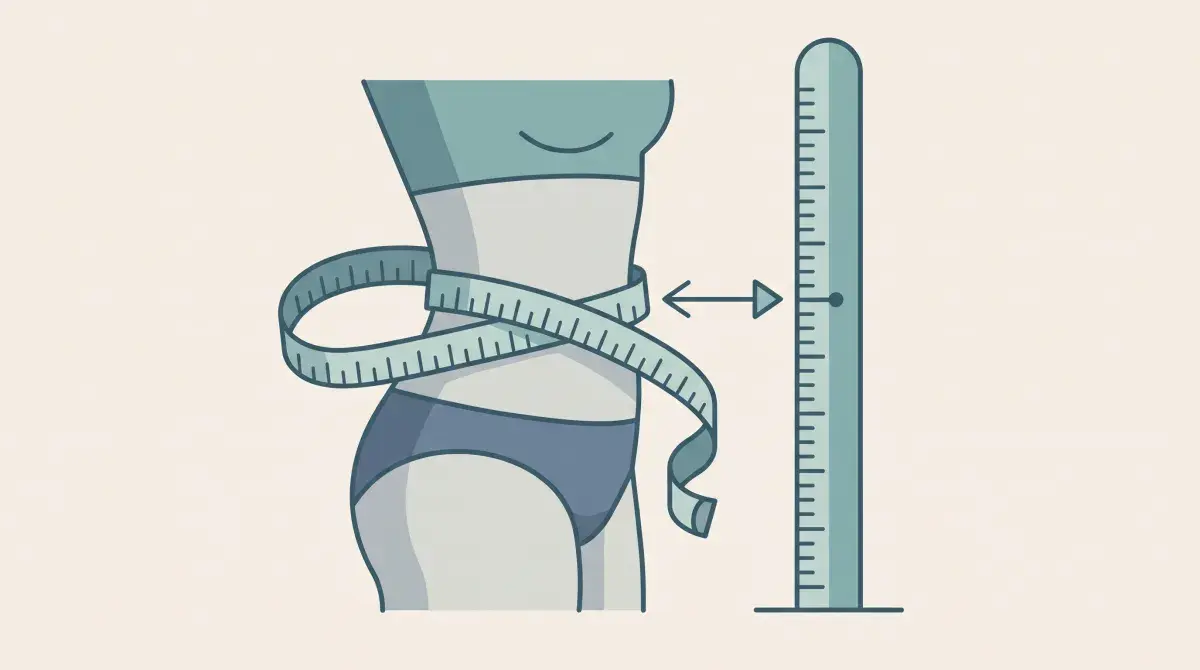
A healthy waist-to-height ratio (WHtR) is below 0.5 — your waist should measure less than half your height. A ratio of 0.4 to 0.49 is healthy, 0.5 to 0.59 signals increased health risk, and 0.6 or higher signals high risk. The rule works for both men and women: divide your waist circumference by your height in the same units, and aim to keep the result under 0.5. It is one of the simplest and most predictive health screens you can do at home with a tape measure.
The Simple Rule: Keep Your Waist Under Half Your Height
In 2022 the UK's National Institute for Health and Care Excellence (NICE) updated its obesity guidance to recommend that adults with a BMI under 35 use waist-to-height ratio as an additional check, with the plain-language target: keep your waist to less than half your height. So a person who is 170 cm tall should keep their waist under 85 cm; someone 6 feet (72 inches) tall should keep it under 36 inches. The number cuts through the confusion of weight charts into a single, memorable target.
The appeal is that WHtR captures where you carry fat, not just how much you weigh. Fat stored around the abdomen — visceral fat that wraps around the organs — is the metabolically dangerous kind, and it is exactly what a waist measurement detects and the scale misses.
How to Measure Your Waist Correctly
Accuracy depends on measuring in the right place. Find the midpoint between the bottom of your lowest rib and the top of your hip bone — for most people this sits at about the level of the navel. Wrap a tape snugly (not tight enough to compress the skin) around that point while standing relaxed, and take the reading at the end of a normal exhale. Do not suck in your stomach. Then divide by your height measured in the same units.
Because WHtR is a ratio, the units cancel: 33 inches ÷ 66 inches gives the same 0.50 as 84 cm ÷ 168 cm. If you would rather not do the arithmetic, our waist ratio calculator handles the measurement math, and the body fat calculator uses the same waist measurement in the U.S. Navy method to estimate your overall body fat percentage.
Waist-to-Height Ratio Risk Zones
The boundaries below come from the classification popularized by Margaret Ashwell and colleagues and adopted in the NICE guidance. They apply to adults of both sexes.
| WHtR | Category | What it means |
|---|---|---|
| Below 0.40 | Underweight (possible) | May indicate too little central tissue; check with a clinician |
| 0.40 – 0.49 | Healthy | Waist is under half your height — the target zone |
| 0.50 – 0.59 | Increased risk | Elevated central fat; lifestyle changes advised |
| 0.60 and above | High risk | High central adiposity; strongly associated with cardiometabolic disease |
To make the target concrete, here is the maximum healthy waist (WHtR 0.49) at a range of heights:
| Height | Max healthy waist (~0.49) | Risk threshold (0.50) |
|---|---|---|
| 5'2" (157 cm) | ~30.5 in / 77 cm | 31 in / 78 cm |
| 5'6" (168 cm) | ~32.5 in / 82 cm | 33 in / 84 cm |
| 5'10" (178 cm) | ~34.5 in / 87 cm | 35 in / 89 cm |
| 6'0" (183 cm) | ~35.5 in / 90 cm | 36 in / 91 cm |
| 6'2" (188 cm) | ~36.5 in / 92 cm | 37 in / 94 cm |
Why WHtR Often Beats BMI
BMI is a fast population screen, but it cannot tell muscle from fat and it is blind to fat distribution. Waist-to-height ratio fixes the second problem directly. The Ashwell, Gunn, and Gibson 2012 meta-analysis (PMID 22106927), pooling data on more than 300,000 adults, found WHtR was a stronger predictor of diabetes, hypertension, and cardiovascular outcomes than BMI. A muscular athlete flagged as "overweight" by BMI usually has a healthy WHtR; a normal-BMI person carrying central fat — the "skinny fat" phenotype — is often flagged by WHtR even though BMI clears them.
This does not make BMI useless; it makes the two complementary. We compare the metrics in depth in BMI vs body fat percentage, and the related question of tracking composition over time in lean body mass vs body fat. For most people, checking BMI plus WHtR takes 60 seconds and gives a far better picture than either number alone.
How to Improve Your Ratio
You cannot spot-reduce belly fat — no crunch, wrap, or supplement selectively burns abdominal tissue. Lowering your WHtR means lowering overall body fat, and the mechanism is the same one behind every successful fat-loss plan: a sustained, moderate calorie deficit paired with resistance training and enough protein to keep muscle. The encouraging part is that visceral fat is among the first fat mobilized during weight loss, so your waist often shrinks faster than the scale early in a diet.
To put numbers on it, work out your maintenance calories with the TDEE calculator, then set a deficit using our guide on how many calories to eat to lose weight. A rate of 0.5 to 1.0 percent of bodyweight per week protects muscle while central fat comes off. Track your waist every couple of weeks alongside the scale — it is often the more motivating number because it moves visibly even during a scale plateau. For readers also weighing the cost of a gym membership or better groceries against the payoff, the budgeting tools at pay.thicket.sh can help you plan the spend.
The Bottom Line
Keep your waist to less than half your height — a waist-to-height ratio under 0.5 — and you clear one of the most predictive, lowest-effort health screens available. It works for men and women, needs only a tape measure, and captures the central fat that BMI and the bathroom scale both miss. Measure it today, check it against the table above, and if you are over 0.5, the lever is overall fat loss, not a targeted belly workout.
Frequently Asked Questions
Check Your Numbers
Use the CalcFit calculators to measure your waist ratio and estimate your body fat percentage from the same tape measurement.