How Much Protein Do I Need to Build Muscle?
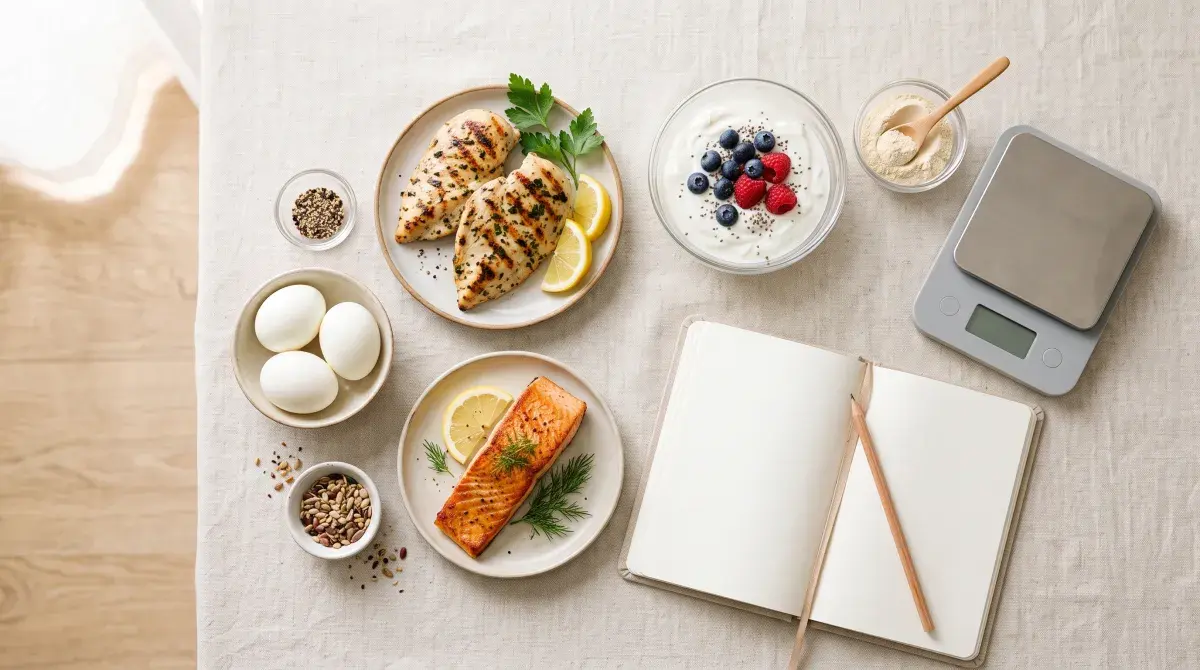
To build muscle, most people need about 1.6 to 2.2 grams of protein per kilogram of bodyweight per day (roughly 0.7 to 1.0 gram per pound). That range is not a guess or a marketing number — it comes from a 2018 meta-analysis of 49 studies and 1,863 participants, and it is the single most reliable nutrition target you can set for muscle growth. Below is exactly where the number comes from, how to calculate yours, and where the common myths fall apart.
The Evidence-Based Protein Range
The anchor study is the Morton et al. 2018 meta-analysis in the British Journal of Sports Medicine (PMID 28698222). Pooling 49 randomized trials, the authors found that protein supplementation significantly increased strength and lean mass during resistance training — but the benefit plateaued at approximately 1.6 g/kg/day. Beyond that intake, extra protein did not produce measurably more muscle for the average trained person.
The International Society of Sports Nutrition (ISSN) position stand on protein (Jager et al. 2017, PMID 28642676) reaches the same practical conclusion, recommending 1.4 to 2.0 g/kg/day for building and maintaining muscle in active individuals. The commonly cited 1.6 to 2.2 g/kg range simply takes the well-supported floor (~1.6) and adds headroom (~2.2) for people who are dieting, older, or want a margin of safety.
| Goal / situation | Protein target | Source |
|---|---|---|
| Building muscle (general) | 1.6–2.2 g/kg/day | Morton 2018 + ISSN |
| Minimum effective dose | ~1.6 g/kg/day | Morton 2018 plateau |
| Cutting (calorie deficit) | 2.0–2.4 g/kg/day | Helms 2014 |
| Older adults building muscle | 1.2–1.5 g/kg/day | PROT-AGE 2013 |
| Sedentary (RDA, not muscle-building) | 0.8 g/kg/day | US/WHO RDA |
Note how far the muscle-building target is above the government RDA of 0.8 g/kg. The RDA is the amount that prevents deficiency in a sedentary person — it was never designed for someone trying to add muscle. This gap is the single most common reason people under-eat protein.
How to Calculate Your Protein Target
The math is simple. Take your bodyweight in kilograms and multiply by 1.6 to 2.2. In pounds, multiply by roughly 0.7 to 1.0.
- Metric: bodyweight (kg) × 1.6–2.2 = grams of protein per day
- Imperial: bodyweight (lb) × 0.7–1.0 = grams of protein per day
For example, a 70 kg (154 lb) lifter targets roughly 112 to 154 g/day; an 90 kg (198 lb) lifter targets roughly 144 to 198 g/day. If you would rather not do the arithmetic, our protein calculator takes your weight, activity level, and goal and returns a personalized number, and the macro calculator slots that protein into a full daily calorie and macronutrient plan.
Protein by Bodyweight — Reference Table
| Bodyweight | Lower target (1.6 g/kg) | Upper target (2.2 g/kg) |
|---|---|---|
| 50 kg / 110 lb | 80 g/day | 110 g/day |
| 60 kg / 132 lb | 96 g/day | 132 g/day |
| 70 kg / 154 lb | 112 g/day | 154 g/day |
| 80 kg / 176 lb | 128 g/day | 176 g/day |
| 90 kg / 198 lb | 144 g/day | 198 g/day |
| 100 kg / 220 lb | 160 g/day | 220 g/day |
| 110 kg / 242 lb | 176 g/day | 242 g/day |
If you carry substantial body fat, calculate from lean body mass or a target bodyweight instead — otherwise the number over-inflates. Our lean body mass calculator gives you that figure.
Timing and Distribution
Once your daily total is set, distribution is a minor optimization — not a make-or-break factor. The Schoenfeld 2013 meta-analysis on nutrient timing (PMID 24299050) found that the fabled post-workout "anabolic window" effect mostly vanished once total daily protein was matched between groups. The window is real but far wider than the 30-minute panic that supplement marketing implies.
That said, spreading protein across the day does help. The practical guideline from Schoenfeld & Aragon 2018 (PMID 29497353) is roughly 0.4 g/kg per meal across 3 to 5 meals, which maximizes the number of times you cross the leucine threshold that triggers muscle protein synthesis. For a 70 kg person that is about 28 g of protein per meal, four times a day.
You do not need to worry about the old "30 g cap per meal" claim — a 2023 study showed the body uses far more than 30 g from a single large dose. We break that down in the 30 g cap article.
Best Protein Sources
Protein quality is measured by amino acid completeness and digestibility (the DIAAS/PDCAAS scales). Animal proteins score highest; plant proteins are effective but usually need to be combined and eaten in slightly larger amounts.
| Source | Protein per serving | Notes |
|---|---|---|
| Chicken breast (100 g) | 31 g | Complete, lean, high leucine |
| Whey protein (1 scoop, ~30 g) | 24 g | Fast-digesting, highest leucine |
| Greek yogurt (170 g) | 17 g | Complete, includes slow casein |
| Eggs (2 large) | 12 g | Complete, gold-standard reference |
| Lentils (1 cup cooked) | 18 g | Plant; pair with grains |
| Tofu / tempeh (100 g) | 12–19 g | Soy is a complete plant protein |
Whole foods can cover your entire target; protein powder is just a convenient top-up when whole-food protein is hard to reach. If you build muscle and lose fat at the same time, protein does double duty — see our body recomp protein guide for the higher targets that a recomposition demands.
Common Protein Myths
- "More protein always builds more muscle." False. Gains plateau near 1.6 g/kg/day (Morton 2018). Extra protein aids satiety but not extra hypertrophy.
- "Protein damages healthy kidneys." False in people with normal kidney function. A 2018 meta-analysis by Devries et al. (PMID 29722584) found high-protein diets did not harm kidney function in healthy adults.
- "You can only absorb 30 g per meal." False. The absorption ceiling is a myth; larger doses are used, just more slowly (Trommelen 2023).
- "Plant protein can't build muscle." False. With adequate total protein and resistance training, plant-based athletes match gains (Lim 2021).
The Bottom Line
For muscle growth, aim for 1.6 to 2.2 g of protein per kg of bodyweight per day (0.7 to 1.0 g/lb), spread across 3 to 5 meals. That range is anchored by the Morton 2018 meta-analysis and the ISSN position stand, and it holds whether your protein comes from chicken, whey, or lentils. Timing is a minor tweak; total daily protein is the lever. Everything else — the exact source, the powder brand, the meal count — is downstream of hitting that number consistently while you train hard and eat enough total calories.
Ready to set your number? Run the protein calculator, then build the full plan with the macro calculator and check your maintenance calories with the TDEE calculator.
Frequently Asked Questions
Find Your Exact Protein Number
Enter your weight and goal and get a personalized daily protein target in seconds.