Protein Distribution Per Meal & the Leucine Threshold (2026)
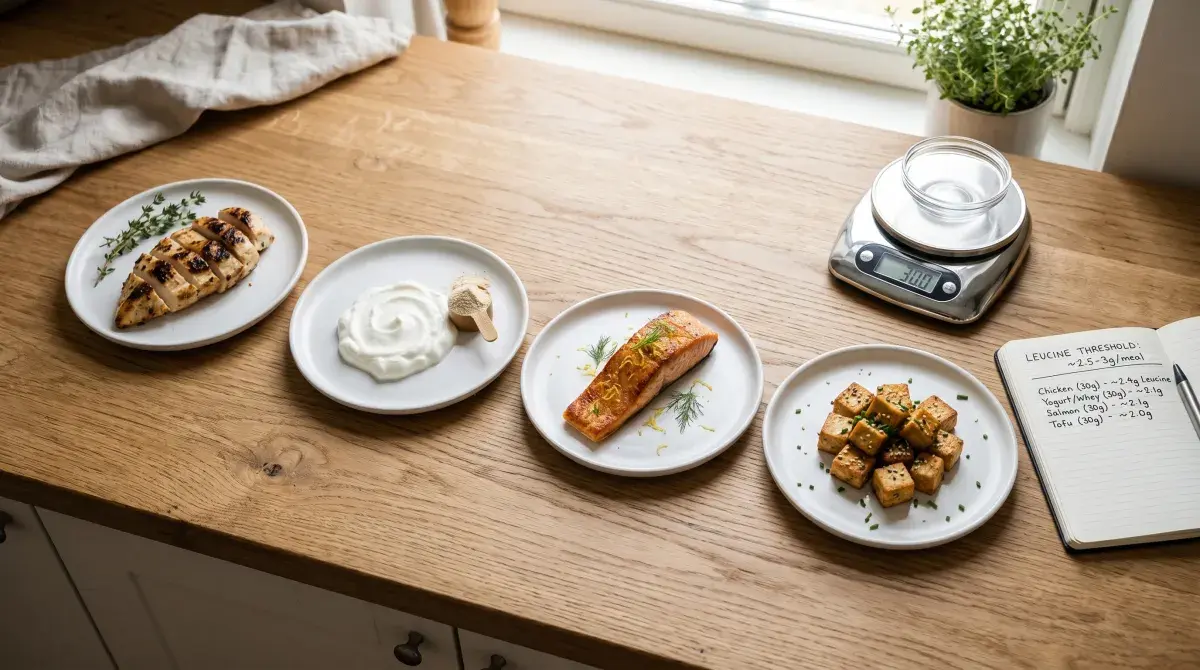
The most common protein mistake is not undershooting the daily total — it is winning the daily total and losing the per-meal math. A lifter who hits 150 g of protein per day in a 10 g breakfast, a 25 g lunch, and a 115 g dinner produces a fundamentally different muscle protein synthesis (MPS) curve than the same 150 g spread across four 38 g meals. The daily ceiling looks identical on a tracking app. The biological output is not. This article walks through the leucine threshold, the per-meal dose that clears it, the Areta 2013 and Mamerow 2014 RCT evidence, and the worked plans. For the daily total, the protein calculator gives you the bodyweight-and-goal-adjusted number to divide across meals.
The Leucine Threshold: What Actually Triggers MPS
Muscle protein synthesis is the cellular process of building new muscle tissue. Eating protein does not produce a smooth, linear MPS response — it produces a threshold response. Below a critical per-meal dose, MPS rises modestly. Above that dose, MPS hits a near-maximal plateau. The amino acid that sets the threshold is leucine.
Leucine activates mTORC1, the cellular signaling complex that initiates protein synthesis. Until intracellular leucine rises above roughly 2.5-3.0 g per eating window, mTORC1 stays only weakly activated. Above threshold, mTORC1 fully engages and MPS climbs to its per-meal ceiling. This is why a 10 g protein dose produces less than half the MPS response of a 25 g dose — the smaller dose fails to clear the trigger. The mechanism is detailed in the protein pillar and validated in Moore et al. 2009 (PMID 19056590).
Total daily protein still matters — leucine clearance per meal is a necessary, not sufficient, condition — but the per-meal threshold is what turns the daily total into actual muscle. A lifter hitting 200 g per day in two giant meals leaves 30-40% of potential MPS on the table versus the same 200 g across four threshold-clearing meals.
The 0.4 g/kg Per-Meal Rule
The operative per-meal protein dose, from the Witard 2014 dose-response RCT in young men (PMID 24257722) and the Moore 2015 meta-regression (PMID 25257958), is 0.4 g per kg of bodyweight for adults under 60, and 0.5-0.6 g/kg for adults over 60. Below that, MPS is sub-maximal. Above it, the response plateaus — extra grams beyond the per-meal ceiling are oxidized for energy or shunted to other amino acid pools rather than driving additional MPS in that window.
| Bodyweight | Under 60 (0.4 g/kg) | Over 60 (0.55 g/kg) | Approx leucine in 30 g whey/chicken |
|---|---|---|---|
| 60 kg | 24 g per meal | 33 g per meal | 2.7 g leucine |
| 70 kg | 28 g per meal | 39 g per meal | 2.7 g leucine |
| 80 kg | 32 g per meal | 44 g per meal | 2.7 g leucine |
| 90 kg | 36 g per meal | 50 g per meal | 2.7 g leucine |
| 100 kg | 40 g per meal | 55 g per meal | 2.7 g leucine |
The per-meal target maps cleanly onto a 4-meal day. A 75 kg lifter at 2.0 g/kg per day (150 g) hits 0.5 g/kg per meal across 4 meals — comfortably above threshold. The 4-meal structure is not arbitrary: it matches the per-meal physiological maximum and the 3-4 hour refractory period between MPS spikes.
What Areta 2013 Actually Found
The Areta 2013 RCT (PMID 23459753) is the empirical foundation for the 4-meal recommendation. The design: 24 trained men, single bout of resistance training, then 80 g of whey protein over 12 hours in one of three schedules — 8 doses of 10 g every 1.5 h, 4 doses of 20 g every 3 h, or 2 doses of 40 g every 6 h. Total protein matched across groups.
| Pattern | Dose & spacing | 12-hour MPS (% above fasted) | Per-meal threshold cleared? |
|---|---|---|---|
| Pulse (frequent small) | 10 g x 8, every 1.5 h | +105% | No (below 2.5 g leucine) |
| Intermediate (even) | 20 g x 4, every 3 h | +138% | Yes |
| Bolus (large infrequent) | 40 g x 2, every 6 h | +98% | Yes — but missed windows |
The 4-meal pattern outperformed both extremes by 31-41%. The frequent-small pattern failed the per-meal threshold on every dose. The bolus pattern cleared the threshold but left 6-hour gaps where MPS had already returned to baseline. The 4-dose pattern matches the muscle's biology: enough leucine each meal to fully engage mTORC1, enough spacing for the refractory period to reset.
Mamerow et al. 2014 (PMID 24477298) replicated the principle in a 7-day RCT. Healthy adults consumed 90 g/day of protein either evenly (31/31/31 g) or skewed (11/16/63 g — the typical American distribution). Even distribution produced 25% higher 24-hour MPS. The skewed group hit threshold only at dinner; the even group hit threshold three times.
The Aging Penalty: Anabolic Resistance
The per-meal threshold rises with age. Skeletal muscle in adults over 60 shows anabolic resistance — the same protein dose produces a smaller MPS response than in younger adults. The Moore 2015 meta-regression found that the per-meal protein dose needed to maximize MPS rises from 0.24 g/kg in young men to 0.40 g/kg in older men. The pragmatic target for any lifter over 60 is 0.55-0.6 g/kg per meal, which for a 75 kg older lifter means 40-45 g per meal rather than the 25-30 g that suffices at 30 years old.
The fix is not just bigger doses — leucine-enriched protein (whey, dairy) or supplemental leucine (3 g co-ingested with a smaller protein dose) effectively lowers the threshold. For older lifters with appetite-driven constraints, leucine fortification turns a 25 g meal into a threshold-clearing one. The recovery side connects to deload weeks for natural lifters.
Worked Daily Distribution: 75 kg Lifter, 150 g Target
The target: 2.0 g/kg, or 150 g of protein for a 75 kg lifter. The distribution: 4 meals at ~38 g each, with optional 10 g casein at bedtime to extend the overnight MPS curve. Every meal clears the 0.4 g/kg per-meal floor (30 g) with headroom for the protein-source quality variability discussed below.
| Meal | Time | Protein | Leucine | Example |
|---|---|---|---|---|
| Breakfast | 7:00 | 38 g | ~3.4 g | 4 eggs + 200 g Greek yogurt + 1 scoop whey |
| Lunch | 12:00 | 38 g | ~3.4 g | 180 g grilled chicken breast + quinoa + vegetables |
| Pre/post train | 17:00 | 38 g | ~3.4 g | 1 scoop whey isolate + 100 g cottage cheese |
| Dinner | 20:00 | 36 g | ~3.2 g | 180 g salmon fillet + 100 g lentils |
| Bedtime (optional) | 22:30 | 10 g | ~0.9 g | 1/2 scoop micellar casein in water |
The casein bedtime dose is below threshold on its own but serves a different function: a 7-9 hour overnight fast otherwise leaves a 14-16 hour window between dinner and breakfast with no amino acid availability. The casein bolus extends low-level amino acid delivery through the overnight window.
Protein Source Quality: Animal vs Plant
The 0.4 g/kg per-meal rule assumes a high-quality, leucine-dense source — whey, dairy, eggs, chicken, fish, lean beef. Whey concentrate is ~11% leucine by weight; chicken breast is ~9%; eggs are ~8.5%; dairy and beef are ~8%. A 30 g serving of whey delivers ~3.3 g of leucine — comfortably above threshold.
Plant proteins are lower in leucine. Rice protein is ~8%, pea protein ~8%, oat protein ~7%, almond protein ~7%, and most legumes ~7%. A 30 g pea-protein serving delivers ~2.4 g of leucine, just at the threshold. For plant-based lifters, the per-meal target rises to roughly 0.5-0.55 g/kg — about 40 g per meal for a 75 kg lifter — to guarantee threshold clearance. Soy and quinoa are the higher-leucine plant exceptions at ~8% each. This is the central operational consequence of the leucine-completeness gap that distinguishes most plant proteins from animal proteins.
The Pre/Post Training Window
The third meal in the worked example sits at the pre/post training window. The "anabolic window" is overstated — MPS sensitivity remains elevated for at least 24 hours after a resistance session, so the meal does not have to be within 30 minutes of the last set. But the meal still needs to clear the per-meal threshold, and a sub-threshold dose around training (a small protein bar, 15 g of whey in water) bleeds an entire MPS spike. The applied training-side context shows up in progressive overload programming.
Practical Implementation: From Daily Total to Per-Meal Plan
- Set your daily total. 1.6-2.4 g/kg depending on goal (cut/recomp/lean bulk) and training status — see the macros for cutting vs bulking for the goal-specific number, or run it through the protein calculator.
- Divide by 4. Four evenly spaced meals, each at 0.4 g/kg or higher. If the per-meal number exceeds 50 g of pure protein, push to 5 meals; if you struggle to hit 4, push the per-meal dose to 45-50 g and run 3 meals.
- Audit each meal against the leucine floor. If a meal is short — typically breakfast — add a scoop of whey or 200 g of Greek yogurt to bring leucine over 2.7-3.0 g.
- Bedtime casein, optional. 10-30 g of micellar casein 30 minutes before sleep extends overnight amino acid availability without disrupting sleep.
- Re-measure at week 4. The tracking cadence in the body recomp targets guide applies here.
Common Distribution Mistakes
Breakfast under-dose
The single most common per-meal threshold failure is breakfast. A bagel with cream cheese (~7 g protein), a bowl of cereal with milk (~12 g), or two slices of toast with peanut butter (~10 g) all fail the threshold. The fix: add 200 g of Greek yogurt or 1 scoop of whey to whatever the existing breakfast is, bringing the dose to 30+ g. This single change typically produces measurable composition improvements within 4-6 weeks in lifters who were previously hitting daily total but skewing distribution.
Pre-training "protein bar"
A 200-calorie protein bar delivers 12-15 g of protein — below threshold. As a pre-training snack it satisfies the calorie need but fails the MPS task. Pair it with 1 scoop of whey, or replace it with a full meal.
Plant-based lifter on the 0.4 g/kg rule
A vegan lifter following the omnivore 0.4 g/kg rule with pea or rice protein hits the protein-quantity target but misses the leucine-quantity target. Bump to 0.5-0.55 g/kg or supplement 2-3 g of leucine with one of the lower-quality meals. The plant-vs-animal trade-off connects to the broader source-comparison covered in the protein per meal evidence review.
Late-night giant meal
The 11-16-63 g distribution from the Mamerow study is the American norm. One 60+ g meal at the end of the day is the structural failure. Re-pull 25 g out of dinner and add it to breakfast. Same daily total, very different MPS profile.
Budgeting the Per-Meal Protein Cost
Hitting 35-40 g of protein four times per day for a 75-90 kg lifter typically costs $6-12 per day in 2026 grocery prices. Whey isolate at warehouse-club pricing is the cheapest per-gram source, followed by frozen chicken breast in bulk, large-pack eggs, and plain Greek yogurt. To check whether the per-meal protein line fits your monthly take-home, the paycheck calculator at PayScale Pro works the budget backward from net rather than gross income.
The Bottom Line
Total daily protein is the ceiling. Per-meal leucine is what turns that ceiling into actual muscle. The operative rule: 0.4 g/kg per meal for adults under 60, 0.55 g/kg for adults over 60, 0.5 g/kg for plant-based lifters, spread across 4 evenly spaced meals 3-4 hours apart. The Areta 2013 4-dose pattern outperformed both extremes by 31-41%. The Mamerow 2014 even-distribution pattern produced 25% higher MPS than the skewed American norm. The Moore 2009/Witard 2014 dose-response work pinned the per-meal threshold at the 0.31-0.4 g/kg range. The PMIDs converge.
The fastest way to convert this into your daily plan: run your bodyweight and goal through the protein calculator, divide the daily total by 4, audit each meal against the leucine threshold, and re-measure at week 4. The macro calculator sets carbs and fat around the per-meal protein floor.
Frequently Asked Questions
Set Your Per-Meal Protein Target
Plug your bodyweight and training goal into the CalcFit protein calculator to get your daily total, then divide by 4 for the per-meal dose.