Does Protein Make You Gain Weight?
Only the way any food does — by adding energy you do not use. There is no macronutrient that cannot make you gain weight in a large enough surplus, and protein is not exempt from energy balance. What is true is that it is the macronutrient least likely to, for three reasons you can measure separately.
1. You pay a toll to digest it
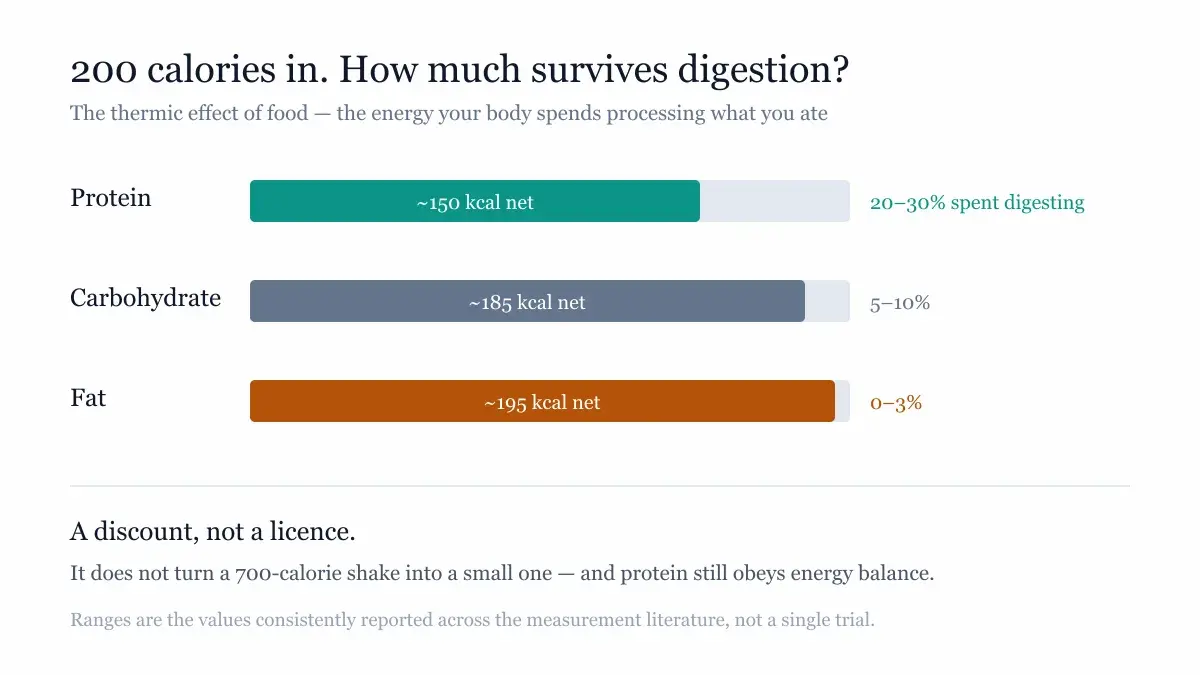
Digesting, absorbing and processing food costs energy — the thermic effect of food — and protein is by far the most expensive to handle.
| Macronutrient | Energy spent digesting it | 200 kcal nets you about |
|---|---|---|
| Protein | 20–30% | ~150 kcal |
| Carbohydrate | 5–10% | ~185 kcal |
| Fat | 0–3% | ~195 kcal |
Individual studies land at different points inside those ranges, but the ordering is consistent and the gap between the ends of it is large. It is worth being precise about what this does and does not mean: it is a discount, not a licence. It does not turn a 700-calorie shake into a small one.
2. It makes you less hungry per calorie
Protein is the most satiating macronutrient, and satiety is the mechanism that actually decides most people’s intake. A protein-forward meal displaces later eating in a way an equal-calorie carbohydrate meal tends not to.
This is the reason the practical answer diverges from the theoretical one. In theory protein can make you gain weight. In practice, people who raise protein at a fixed calorie target usually find the target easier to hit, because the same number of calories buys more fullness.
3. A surplus is partitioned differently
Where a surplus goes matters as much as its size. Studies that deliberately overfeed protein to people who are resistance training have generally found smaller increases in fat mass than the extra calories alone would predict — the reason protein overfeeding is often described as unusually forgiving.
Two honest caveats, because this is the finding most often overstated. Those studies are typically in trained people who are lifting, so the partitioning has somewhere to go. And the effect is a blunting, not an exemption. Add protein on top of an already adequate diet, change nothing else, and the surplus still has to go somewhere.
Where protein genuinely does cause weight gain
Almost always in liquid form, and almost always added rather than substituted. A shake with whole milk, a banana, peanut butter and two scoops is not a protein serving; it is a meal, and drunk beside a full dinner it is simply a surplus in a cup. Protein bars have the same problem in solid form — many are confectionery with a protein claim on the wrapper.
The failure mode is not the protein. It is that liquid and snack calories are unusually easy to add on top of what you were already eating.
Why the scale went up in week one
Because it is water, and this catches almost everyone. Raising protein usually arrives alongside more food volume and more sodium, and if training started at the same time, glycogen and the fluid stored with it, plus some inflammation in the worked muscle. All of that registers on a scale within days.
Fat accrues slowly. A two-kilogram jump inside a week is not fat — eating enough to add that much fat in seven days is very hard to do by accident. Judge a protein change on a fortnightly trend. See why your weight fluctuates for the day-to-day noise.
The short version
Protein obeys energy balance like everything else, and then makes that balance easier to hold: a fifth to a third of it is spent on digestion, it blunts appetite more than the alternatives, and what does get stored is more likely to end up as lean mass if you are training. If your weight is rising on a higher-protein diet, the thing to audit is what the protein was added to.
General information, not medical or dietary advice. Ranges given for the thermic effect of food are the values consistently reported across the measurement literature rather than a single trial; individual studies vary inside them. If you have kidney disease or another condition affecting protein handling, this is a question for your doctor.
Related
- How much protein to build muscle
- Is protein powder bad for your kidneys?
- Is there really a 30g protein cap per meal?
- Why am I not losing weight in a calorie deficit?