Does Creatine Make You Gain Weight?
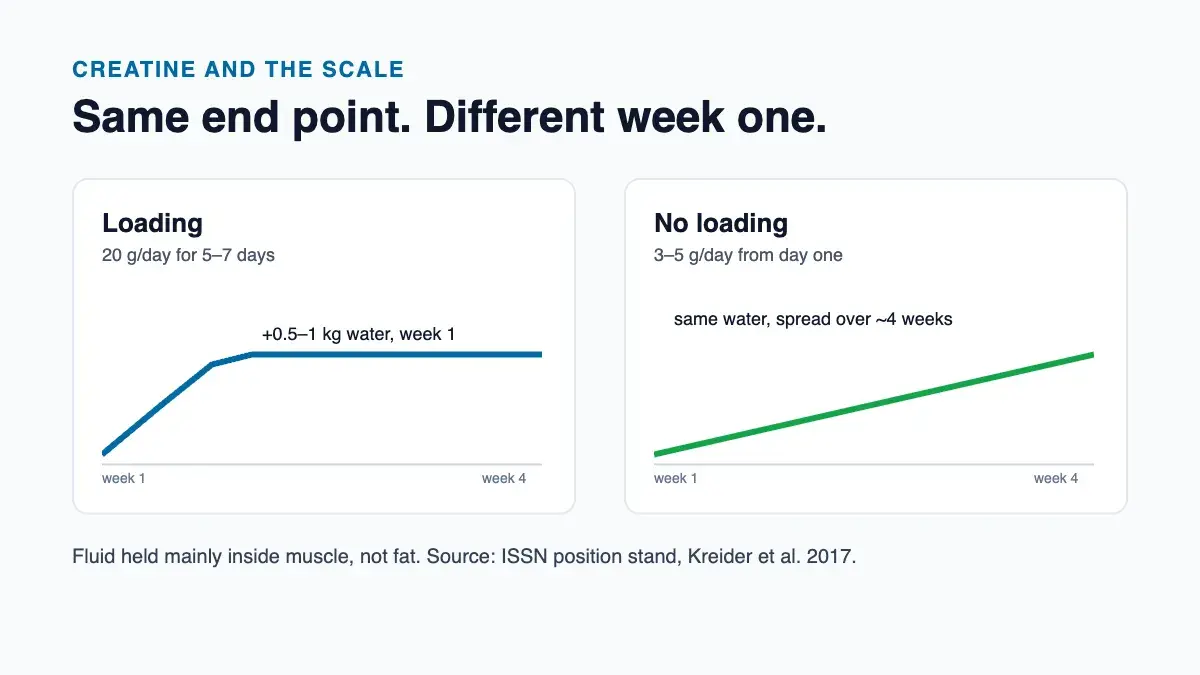
Usually a little, and fast, if you load it: roughly half a kilogram to a kilogram in the first week. The gain is water, most of it held inside muscle, not fat. The International Society of Sports Nutrition calls weight gain the only consistently reported side effect of creatine, and puts the early fluid retention at about 0.5 to 1.0 litres.
Where the number comes from
Creatine is stored in muscle, and supplementing raises muscle creatine and phosphocreatine by about 20–40%, according to the ISSN’s 2017 position stand. Creatine is osmotically active, so muscle holds extra water alongside it. The position stand reports that creatine loading “promoted a short-term fluid retention (e.g., about 0.5 – 1.0 L) that was generally proportional to the acute weight gain observed.”
A litre of water weighs a kilogram. That is why the scale moves the way it does: a half-kilogram to one-kilogram rise, arriving within days, then levelling off.
Loading vs. not loading
How fast the water arrives depends almost entirely on how you start. Both routes end at the same place.
| Loading | No loading | |
|---|---|---|
| Dose | 5 g four times a day (about 0.3 g/kg/day) for 5–7 days, then 3–5 g/day | 3–5 g/day from day one |
| Muscle stores full | About one week | About four weeks |
| What the scale shows | A visible jump in week one | A gradual drift, easily lost in daily noise |
| Where you end up | Same muscle creatine | Same muscle creatine |
The ISSN position stand describes 3 g/day for 28 days as an alternative that gives “only a gradual increase in muscle creatine content compared to the more rapid loading method”. If the week-one jump worries you, that gradual increase is the point: the same water is spread over a month instead of a week. More on the trade-off in creatine loading vs. maintenance.
It is not fat
The evidence on fat mass is consistent. A 2021 review by twenty creatine researchers in the Journal of the International Society of Sports Nutrition (Antonio et al.) concluded that “creatine supplementation does not increase fat mass across a variety of populations,” drawing on studies from about a week to two years long.
It goes slightly further than neutral. The review cites a meta-analysis by Forbes and colleagues: 19 randomised trials, 609 adults aged 50 and over, all resistance training. The creatine groups had a greater reduction in body fat percentage than placebo. That is one population, and a body fat percentage partly reflects added lean mass, so read it as “does not add fat”, not “burns fat”.
How long the water weight lasts
The water shift is front-loaded. The 2021 review describes early work in which three days of creatine raised total body water. But when resistance-trained people took about 20 g/day for 7 days and then about 5 g/day for four more weeks, researchers found “no significant change” in intracellular, extracellular or total body water. The review’s summary is that over longer periods creatine does not appear to change body water relative to muscle mass.
In practice: the first-week step is real, and it does not keep climbing. Weight that keeps rising over the following months, in someone who is lifting, is more plausibly muscle. That is the effect people take creatine for. See does creatine work for the performance evidence.
Bloating is a different question
The water creatine pulls in sits mainly inside muscle cells. That does not make your stomach feel distended or your face look puffy. The ISSN position stand reports that creatine does not increase the incidence of gastrointestinal upset. If you do load, take the 20 g as four separate 5 g doses, which is how the protocol is written. And if the sensation bothers you, skip loading: nothing in the end state requires it.
Reading the scale during a cut
This is where the water matters. Someone in a 500-calorie deficit loses roughly half a kilogram a week. Start loading creatine that same week and the scale can read flat, or even up, while fat loss continues underneath. Two rules keep that from derailing a diet:
- Do not change your calories because of week one. The jump is the predictable water effect, not a stalled deficit.
- Compare weekly averages two weeks apart. Once muscle stores are full the water stops accumulating, and the trend underneath shows through again. The day-to-day noise is covered in why your weight fluctuates.
If you are starting creatine and a diet together, starting creatine without a loading phase makes the scale much easier to interpret.
The short version
Creatine adds weight the way a sponge does: it holds water in muscle, about 0.5–1 kg when loaded, and it does not add fat. Load it and you see the step in a week. Take 3–5 g a day instead and the same change is spread over a month. Either way, judge your progress on the two-week trend, not on the morning after.
Sources
- Kreider RB, et al. International Society of Sports Nutrition position stand: safety and efficacy of creatine supplementation in exercise, sport, and medicine. J Int Soc Sports Nutr. 2017;14:18. doi:10.1186/s12970-017-0173-z
- Antonio J, et al. Common questions and misconceptions about creatine supplementation: what does the scientific evidence really show? J Int Soc Sports Nutr. 2021;18:13. doi:10.1186/s12970-021-00412-w
General information, not medical advice. The fluid figures are those reported in the ISSN position stand and are averages; individuals vary. If you have kidney disease or take medication affecting fluid balance, ask your doctor before supplementing.
Related
- Does creatine work?
- Creatine loading vs. maintenance
- Does creatine cause hair loss?
- Why does my weight fluctuate?