Does Creatine Actually Work? (And Is It Safe?)
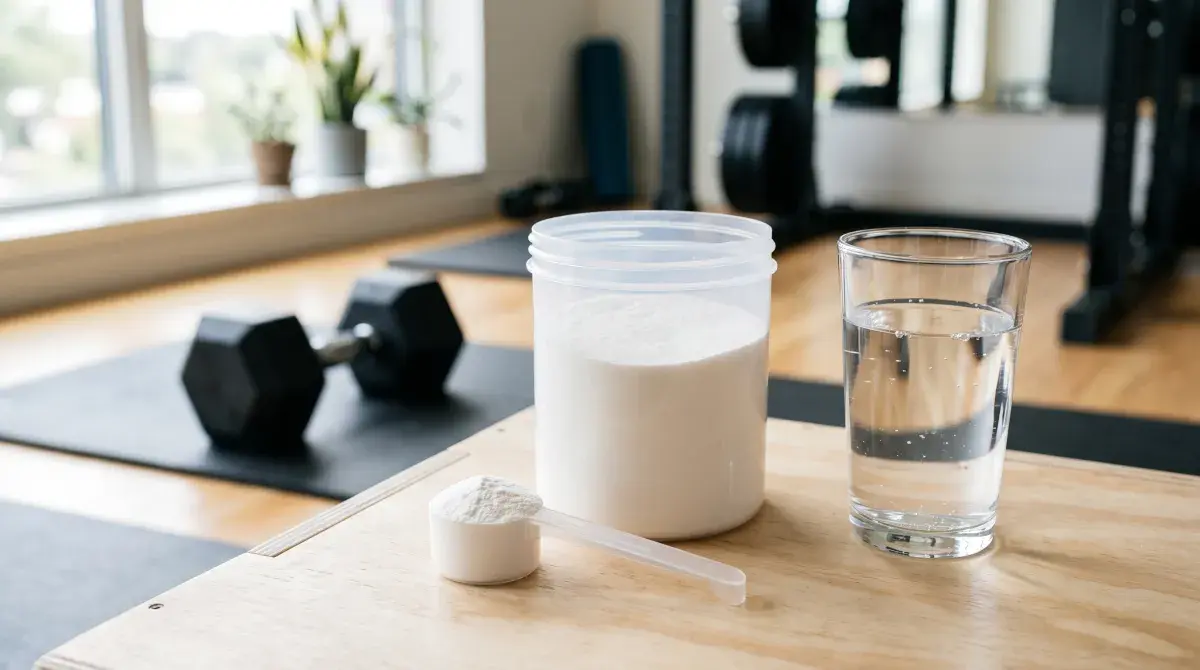
Yes — creatine monohydrate genuinely works, and for healthy people it is safe. Decades of trials show it reliably increases strength and muscle when paired with resistance training, and it does not damage the kidneys of healthy adults. It is the rare supplement where the evidence is not just positive but overwhelming. Here is exactly what the research shows on efficacy, the safety data behind the debunked kidney myth, and how to dose it.
Does Creatine Work? The Efficacy Evidence
Creatine is arguably the most-studied sports supplement in existence, with hundreds of controlled trials. The ISSN position stand (Kreider et al. 2017, PMID 28615996) — the authoritative expert consensus — calls creatine monohydrate "the most effective ergogenic nutritional supplement currently available" for increasing high-intensity exercise capacity and lean body mass during training.
The magnitude is meaningful. A meta-analysis by Chilibeck et al. 2017 (PMID 30675204) found that adding creatine to a resistance-training program produced roughly 1.1 kg more lean mass over 6 to 12 weeks than training alone. Strength gains are similarly consistent, with typical bench-press and squat improvements landing in the 5 to 15% range above placebo. The mechanism is well understood: creatine raises muscle phosphocreatine, which regenerates ATP faster during hard sets, letting you do slightly more work each session — and that extra work compounds into more muscle over time.
| Outcome | Typical effect of creatine + training |
|---|---|
| Lean mass (6–12 wk) | ~1.1 kg more than training alone (Chilibeck 2017) |
| Maximal strength | +5 to +15% vs placebo |
| High-intensity / sprint capacity | Consistently improved |
| Muscle phosphocreatine stores | +10 to +40% (higher in vegetarians) |
Is Creatine Safe? The Kidney Myth, Debunked
The most persistent fear about creatine is that it damages the kidneys. It does not — in healthy people, and the confusion has a specific, understandable cause.
Creatine is metabolized into creatinine, a waste product that doctors measure in blood to estimate kidney function. Supplementing creatine raises serum creatinine slightly — not because your kidneys are struggling, but simply because you are consuming more of the precursor. A standard lab panel can therefore look alarming while kidney function is completely normal. This is a measurement artifact, not damage.
The controlled data is clear. The ISSN safety review (Kreider 2017, PMID 28615996) concluded there is no evidence that long-term creatine use harms kidney or liver function in healthy people, citing studies running up to 5 years. A dedicated 2021 analysis by Antonio et al. (PMID 33557850) reviewed the common concerns — kidney damage, hair loss, dehydration, cramping — and found the evidence does not support them in healthy individuals.
The two real caveats: people with pre-existing kidney disease should talk to a doctor before supplementing, and everyone should expect a small water-weight gain (1 to 2 kg) as creatine pulls water into muscle cells. That intracellular water is part of the mechanism, not a side effect to avoid.
How to Dose Creatine
Dosing is refreshingly simple, and this is where most of the marketing noise lives.
| Protocol | Dose | Time to full saturation |
|---|---|---|
| Maintenance only (recommended default) | 3–5 g/day, every day | ~3–4 weeks |
| Loading phase (optional) | 20 g/day (4 × 5 g) for 5–7 days, then 3–5 g/day | ~1 week |
Both protocols reach the same muscle saturation — loading just gets you there faster. The Hultman 1996 study (PMID 8828669) demonstrated that a low steady 3 g/day dose matched the muscle creatine levels of a loading protocol after about a month. Take it every day, including rest days, because the goal is keeping your muscle stores topped up, not timing it around workouts. If you want to dig into timing specifically, see our creatine timing evidence review and the loading vs maintenance breakdown.
Which Form? Monohydrate Wins
Supplement shelves are full of "advanced" creatine forms — HCl, buffered (Kre-Alkalyn), ethyl ester, liquid — usually sold at several times the price of plain monohydrate. None of them have beaten monohydrate in head-to-head trials. The ISSN position stand explicitly names creatine monohydrate as the most effective and best-supported form. Our creatine HCl vs monohydrate review walks through the head-to-head data; the short version is that monohydrate wins on evidence and on cost.
Who Benefits Most?
- Lifters and strength athletes — the core use case, with the largest and most reliable effect.
- Vegetarians and vegans — often the strongest responders, because dietary creatine comes mainly from meat and fish, so their baseline stores are lower.
- Team-sport and sprint athletes — repeated high-intensity efforts benefit from faster ATP regeneration.
- Older adults — emerging research supports creatine (with resistance training) for preserving muscle and possibly cognition with age.
Endurance-only athletes see a smaller direct performance effect and the water weight is a minor consideration; even so, many use it for improved training quality. If you are a runner or cyclist weighing that trade-off, our creatine for endurance athletes guide covers it in detail.
The Bottom Line
Creatine monohydrate is one of the very few supplements that lives up to the hype: it reliably adds strength and roughly a kilogram of extra lean mass over a training block (Chilibeck 2017), and it is safe for healthy people — the kidney fear is a lab-value misunderstanding, not real damage (ISSN 2017; Antonio 2021). Take 3 to 5 g/day of plain monohydrate, every day, skip the fancy forms, and load only if you want the benefit within a week instead of a month. Pair it with adequate protein and progressive training and it is one of the highest-return, lowest-cost decisions you can make.
Creatine works best on top of solid fundamentals. Set your protein target with the protein calculator, dial in maintenance calories with the TDEE calculator, and plan a lean-gain or recomp with the body recomp calculator.
Frequently Asked Questions
Build Your Plan Around Real Numbers
Creatine is the easy part. Get your protein and calorie targets right with our calculators.