HRV Training — Signal vs Noise (Evidence Review)
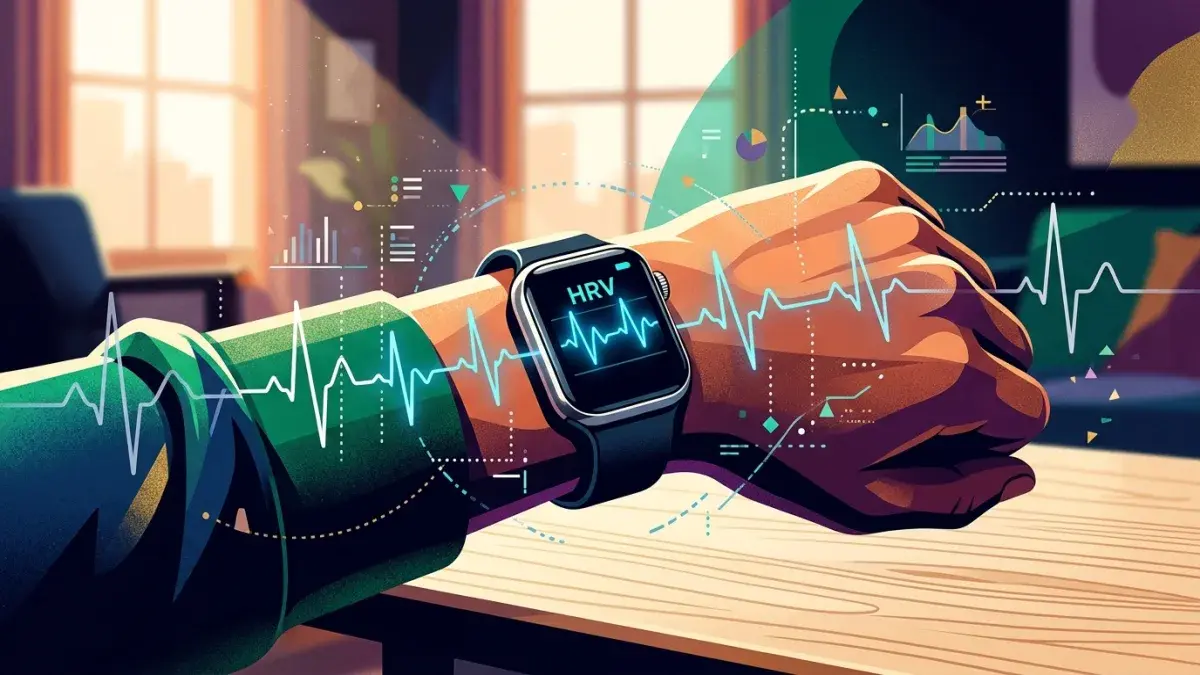
Heart rate variability has gone from obscure cardiology metric to the flagship “recovery” number on every wrist wearable on the market. Whoop scores, Oura readiness, Garmin Body Battery, Apple Watch Fitness — all use HRV under the hood. The science is real. The marketing is oversold. Here is what the peer-reviewed evidence says about HRV as a training tool, and how to pull useful signal out of noisy daily readings.
What HRV Actually Measures
Your heart does not beat like a metronome. Even at rest, the interval between heartbeats varies slightly — a few milliseconds shorter on inhale, a few milliseconds longer on exhale. This beat-to-beat variation is governed by the autonomic nervous system, with parasympathetic (vagal) input lengthening intervals and sympathetic input shortening them.
HRV quantifies that variation. The most commonly reported metric is rMSSD (root mean square of successive differences), which captures short-term vagal tone. Typical overnight rMSSD ranges:
| Group | Typical rMSSD range (ms) |
|---|---|
| Elite endurance athletes | 70-120+ |
| Fit adults (20-40 y) | 40-80 |
| Sedentary adults | 25-50 |
| Older adults (60+) | 15-40 |
The numbers vary enormously between individuals — as much as 5x — driven by genetics, age, sex, fitness, and sleep habits. This is the single most important point in the entire HRV conversation: never compare your HRV to someone else's. Compare it to your own rolling baseline.
The Training Signal: HRV-Guided vs Fixed Programs
Javaloyes et al. 2020 meta-analysis in International Journal of Sports Physiology and Performance (PMID 33036574) reviewed trials comparing HRV-guided to fixed-program training. The typical protocol:
- Measure HRV every morning.
- On days where HRV is within (or above) the rolling baseline — do the planned hard session.
- On days where HRV drops below baseline by more than 1 SD — reduce intensity (drop to Zone 2) or cut volume by a third.
The pooled effect favored HRV-guided training: small but consistent improvements in VO2 max (~2-5%) and time trial performance over 4-12 week interventions. Kiviniemi et al. 2010 (PMID 21057293) — one of the cleaner RCTs — showed HRV-guided runners improved 3000m time trial performance about 3% more than fixed-program runners over 8 weeks.
The effect is meaningful for competitive endurance athletes. For recreational lifters and general fitness trainees, the gain is typically smaller than good programming, adequate sleep, or progressive overload.
Wearable Accuracy: What's Actually Measured
HRV measurement accuracy depends heavily on the sensor:
| Sensor type | Correlation with ECG (at rest) |
|---|---|
| ECG (gold standard) | 1.0 |
| Chest strap (Polar H10, Garmin HRM-Pro) | 0.95-0.99 |
| Finger PPG (HRV4Training phone cam) | 0.9+ |
| Ring (Oura 3/4) | 0.85-0.92 |
| Wrist optical (Apple Watch, Whoop, Garmin) | 0.75-0.88 |
Düking et al. 2021 (PMID 33512628) reviewed wearable HRV validity and concluded that for trending purposes (comparing today to your 7-day average), modern wrist optical sensors are adequate. For absolute comparisons to literature-reported values, they are not. Whoop and Oura perform best among wrist/ring wearables because they restrict HRV sampling to overnight sleep windows, avoiding motion artifact.
How Noisy Is Day-to-Day HRV?
Very. Normal daily variation around your personal mean is 10-20%. A 50 ms rMSSD athlete can see readings from 42-58 ms on consecutive days with no meaningful difference in recovery state. Flagging a single low-reading day as “overtraining” is reading noise.
The useful approach is to track rolling averages rather than single days:
- 7-day average: smooths daily noise. Represents current recovery state.
- 28-day average: represents your current baseline fitness level.
- Flag days: 7-day avg drops more than roughly 1 SD below 28-day avg — this is a real signal, not noise.
Most apps (HRV4Training, Whoop, Elite HRV) implement some version of this smoothed signal. Trust the rolling averages over raw daily numbers.
What Actually Moves HRV
Ranking inputs by impact (roughly, from most to least):
- Sleep quantity and quality. The single biggest driver. One bad night can drop HRV 10-20%. See our sleep and muscle growth article.
- Alcohol. Two drinks the night before can cut HRV 20-40% on the following morning. Very consistent signal.
- Acute training load. A hard session yesterday depresses today's HRV. Normal and expected.
- Illness onset. HRV often drops 1-2 days before symptoms appear. Worth flagging.
- Emotional stress. Work deadlines, family stress, financial stress all register. Reliably confuses training-focused interpretation.
- Dehydration. Modest effect, usually smaller than the above.
- Caffeine (late-day). Small effect on overnight HRV if consumed after ~2 PM.
For financial stress specifically, our friends at money.thicket.sh have calculators that help reduce one source of ambient cognitive load — which translates surprisingly well to HRV stability.
A Practical HRV Protocol
Here is a minimal, evidence-based way to use HRV without overthinking it:
- Measure overnight or first-morning. Same time, same position, same breath pattern if possible.
- Use rolling averages. Compare today's reading to your 7-day average and your 7-day to your 28-day.
- On a low day (7-day avg drops below 28-day by roughly 1 SD): reduce intensity. Swap intervals for Zone 2. Cut volume by a third.
- On a normal day: proceed with the planned session.
- On a high day: proceed, do not chase extra volume.
- Keep a log. Note sleep, alcohol, stress. Patterns emerge in 4-8 weeks.
Pair HRV tracking with the heart rate zones calculator for your easy-day Zone 2 target, and the max HR calculator for percentage-based zone math. For intensity autoregulation in strength work specifically, the RPE/RIR article covers the lifting equivalent of HRV-guided cardio.
When HRV Is Misleading
- Altitude changes: Travel to high altitude drops HRV for days-to-weeks. Not a training readiness signal — it is acclimatization.
- Menstrual cycle: HRV varies across the cycle in female athletes. Use cycle-aware tracking.
- Heat acclimation: Heavy heat exposure depresses HRV. Not necessarily overtraining.
- Pregnancy: HRV changes substantially. Use specialized tools — our pregnancy.thicket.sh tools cover trimester-specific guidance.
- Medication changes: Beta blockers and certain antidepressants directly affect HRV.
Common Mistakes
- Comparing to other people's HRV. Genetic range is enormous. Only your own baseline matters.
- Reacting to single-day drops. Noise. Use rolling averages.
- Chasing a “recovery score” number. The underlying HRV is the signal. The app's normalized score is marketing.
- Ignoring life stress. HRV integrates training and life. Low HRV with no hard training probably means sleep or stress.
- Abandoning training on a low-HRV day. Reduce, don't skip.
The Bottom Line
HRV is a real physiological signal with modest training value. HRV-guided programming produces small (2-5%) advantages over fixed programs in endurance athletes, per the 2020 Javaloyes meta-analysis. The signal is noisy day-to-day; 7-day and 28-day rolling averages separate it from the noise. Modern wrist wearables are accurate enough for personal trending but not for absolute comparison. The single biggest upstream lever on HRV is sleep. If your HRV is chronically low and you do not know why, look at sleep, alcohol, and life stress before blaming training.
Ready to pair HRV tracking with evidence-based training? Start with the heart rate zones calculator, then run the TDEE calculator to check your fueling baseline.
Frequently Asked Questions
Pair HRV With Zone-Based Training
Use HRV to decide intensity. Use our calculators to set the zones themselves.