Creatine Timing: Pre vs Post-Workout Meta-Analyses (2026)
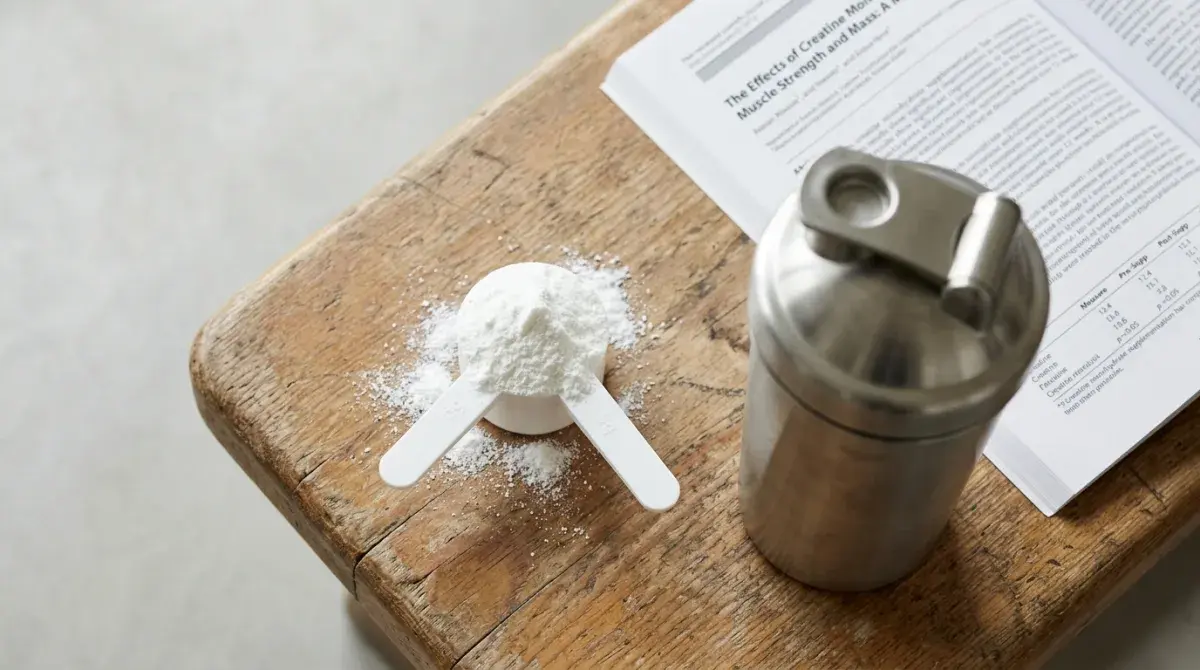
The pre- vs post-workout creatine question is one of the most-asked supplement questions in the lifting world, and the evidence base for it is unusually shallow relative to the volume of opinion. Four head-to-head trials and one consensus position stand effectively define what the peer-reviewed literature can say: Antonio & Ciccone 2013, Candow et al. 2015, Ribeiro et al. 2020, Forbes et al. 2021, and the Kreider et al. 2017 ISSN position stand. This article walks through each one with the actual study-level numbers, then summarizes the consensus and the practical implications.
The pillar guide on this site — creatine timing: does it matter — covers the practical decision in plainer language. This article is the evidence layer underneath it: what each study measured, what dose, in whom, and for how long, with the head-to-head comparisons laid out side by side.
The Four Head-to-Head Trials, Side by Side
These are the four pre- vs post-workout creatine trials that dominate the citation pool. They differ in subject population, training status, study duration, and primary endpoint, but they all asked the same operational question: does the time of day creatine is taken alter the strength or hypertrophy outcome?
| Study | n | Duration | Dose | Population | Timing effect |
|---|---|---|---|---|---|
| Antonio & Ciccone 2013 (PMID 23919405) | 19 | 4 wk | 5 g/day | Trained males | Small post-workout edge; borderline significance |
| Candow et al. 2015 (PMID 26303005) | 39 | 32 wk | 0.1 g/kg/day | Older adults | None — pre and post equivalent |
| Ribeiro et al. 2020 (PMID 32814737) | 27 | 8 wk | 3 g/day | Resistance-trained men | None — timing did not modulate outcomes |
| Forbes et al. 2021 (PMID 33941018) | Pooled | Review | 3-5 g/day | Mixed | None at the pooled level |
Two patterns stand out. The Antonio 2013 result — the one study that found a small post-workout edge — is also the smallest sample and the shortest duration, with the signal at the edge of significance on most endpoints. The three larger or longer studies that followed all came back negative. The pooled timing literature looks more like a non-signal than a real effect.
Antonio & Ciccone 2013: The Study That Started the Conversation
Antonio & Ciccone 2013 (PMID 23919405) randomized 19 recreationally trained male bodybuilders to take 5 g of creatine monohydrate either immediately before or immediately after their resistance training sessions over 4 weeks. Training was 5 days per week, standardized across both groups. Body composition was measured by DXA; strength by 1RM bench press.
The headline outcomes: the post-workout group gained +2.0 kg fat-free mass vs +0.9 kg in the pre-workout group, and added a slightly larger 1RM bench press improvement. The difference reached statistical significance on the fat-free mass endpoint but not on strength, and the magnitude of the lean-mass gap (~1.1 kg in 4 weeks) is large enough to be biologically interesting but small enough that an n=19 trial cannot resolve it confidently. The authors framed the result as suggestive rather than definitive, and explicitly called for larger replication.
Two issues with using Antonio 2013 as a standalone basis for a timing recommendation: the sample is small, and the 5 g flat dose means subjects were still mid-saturation at the 4-week mark. The trial captured the early ramp-up of muscle creatine more than the steady-state effect of timing. The Kreider 2017 ISSN position stand cites it as a hypothesis-generating result that has not yet been replicated at scale.
Candow 2015: 32 Weeks, Older Adults, Zero Timing Effect
Candow et al. 2015 (PMID 26303005) is the longest pre- vs post-workout creatine trial in the literature. Thirty-nine older adults (mean age 57) were randomized to creatine before training, creatine after training, or placebo, and followed for 32 weeks on a supervised resistance training program. The dose was 0.1 g/kg body mass per day — roughly 7-8 g/day for an average-size subject, well above the saturation maintenance threshold.
The results were unambiguous on the timing question: both creatine groups gained significantly more lean tissue mass and strength than placebo (the well-established creatine main effect), but the pre- vs post-workout comparison showed no statistically meaningful difference on any endpoint — lean mass, 1RM bench press, 1RM leg press, or chest press endurance. The authors concluded that timing did not modulate the creatine response in this population.
The Candow trial is the cleanest design in the head-to-head literature: longer duration than Antonio 2013, twice the sample size, and a dose high enough to ensure full muscle saturation well before measurement endpoints. Its null result on timing is the strongest single piece of evidence that the Antonio 2013 effect, if real, is small enough to be washed out by other variables.
Ribeiro 2020: 8 Weeks, Resistance-Trained Men, Another Null Result
Ribeiro et al. 2020 (PMID 32814737) randomized 27 resistance-trained men to 3 g/day creatine monohydrate taken either immediately pre- or immediately post-workout for 8 weeks. Training was 4 sessions per week of standardized upper/lower split resistance training. Endpoints included 1RM bench press, 1RM squat, muscle thickness via ultrasound, and total body lean mass.
Both groups improved significantly from baseline on every endpoint — the standard creatine plus training response — but the between-group comparison was null on every endpoint. The authors concluded that the timing of creatine dosing did not modulate strength or hypertrophy outcomes in resistance-trained men at the doses studied. Their discussion explicitly addressed the Antonio 2013 finding and suggested that the trained-subject pool and longer 8-week window allowed muscle creatine to reach saturation in both groups, eliminating the early-ramp differential that may explain Antonio's small post-workout signal.
Ribeiro 2020 is the most direct replication attempt of Antonio 2013 — same trained-male population, similar dose, longer duration — and it came back negative. This is the pattern most-cited reviews lean on when they describe timing as a minor consideration.
Forbes 2021: The Pooled Review
Forbes et al. 2021 (PMID 33941018) synthesized the timing trial pool through 2020 and concluded that the available evidence does not support a meaningful pre- vs post-workout timing effect, and that the lone positive finding (Antonio 2013) has not been replicated. The recommendation: take creatine consistently at a time that maximizes adherence, with no measurable performance cost to choosing pre or post.
Forbes 2021 also addressed the biological argument. Muscle creatine is a slow-accumulating intracellular pool, not an acute fuel. Plasma concentration during a single workout does not drive performance — steady-state muscle saturation does. This is why the timing question is small at the outcome level even before you look at the trial data.
Kreider 2017 ISSN: The Reference Position Stand
The Kreider et al. 2017 ISSN position stand (PMID 28615996) is the most-cited consensus document in the creatine literature, and it addresses timing directly. The position stand notes that post-exercise dosing may have a minor advantage based on early evidence (Antonio 2013, plus some co-ingestion studies on insulin-mediated creatine uptake), but explicitly states that the magnitude is small relative to total daily dose, consistency, and the loading protocol.
The ISSN's practical hierarchy is worth memorizing: (1) total daily dose of 3-5 g/day matters most; (2) consistency over multi-week windows matters next; (3) loading vs maintenance protocols affect speed of saturation but not end-state outcomes; (4) timing is a minor lever that may or may not be real. The full loading protocol discussion is in the creatine loading protocol meta-analyses comparison, and the loading-vs-maintenance decision tree is in creatine loading vs maintenance: which protocol actually works.
The Strength vs Hypertrophy Nuance
One subtlety: the small post-workout signal in Antonio 2013 was concentrated on the hypertrophy endpoint (fat-free mass) rather than strength (1RM bench). If there is a real timing effect, it is more likely on hypertrophy, and the mechanistic argument is that post-exercise insulin sensitivity slightly enhances creatine uptake into recently-trained muscle. But the Candow 2015 and Ribeiro 2020 trials measured both endpoints and found no timing effect on either. The strength/hypertrophy split is interesting as a hypothesis but does not survive the larger trial pool.
| Study | Pre group outcome | Post group outcome | Between-group p-value |
|---|---|---|---|
| Antonio 2013 — fat-free mass | +0.9 kg | +2.0 kg | p < 0.05 (small n) |
| Antonio 2013 — bench 1RM | +6.6 kg | +7.9 kg | n.s. |
| Candow 2015 — lean mass | Significant vs placebo | Significant vs placebo | n.s. (pre vs post) |
| Candow 2015 — bench 1RM | Significant vs placebo | Significant vs placebo | n.s. (pre vs post) |
| Ribeiro 2020 — all endpoints | Significant from baseline | Significant from baseline | n.s. (pre vs post) |
Why Total Dose and Consistency Beat Timing
The reason timing is a small lever is the underlying kinetics. Muscle creatine takes roughly 28 days at 3-5 g/day to reach saturation, or 5-7 days on a 20 g/day loading protocol per the Hultman et al. 1996 timeline. Once saturated, the pool holds at that plateau as long as the daily replacement dose covers the ~1-2% daily turnover to creatinine. Missing a day shifts the plateau by less than 1%. Taking the same daily dose four hours earlier or later shifts it by approximately zero.
The adherence math matters far more. A subject taking 5 g/day six days a week averages 4.3 g/day — comfortably above the saturation maintenance threshold. A subject taking 5 g/day three days a week averages 2.1 g/day — below it, drifting toward sub-saturation over multi-week windows. Time of day does not appear in this calculation. What appears is total weekly dose and consistency.
The Practical Protocol for 2026
Synthesizing across the timing literature, the practical recommendation looks like this:
- Default: 3-5 g/day creatine monohydrate, taken at a consistent time that maximizes your adherence rate. Pre, post, or any other time of day is fine.
- If you already shake post-workout: fold creatine into the post-workout shake. There is no downside, and the Antonio 2013 signal — if it is real — is at least directionally consistent with that choice.
- If you forget post-workout doses: move it to a more reliable habit anchor (with breakfast, with a daily coffee, with dinner). Adherence dominates timing.
- On rest days: any time. The muscle creatine pool does not care about the clock on a non-training day.
- Co-ingestion: creatine plus 30-50 g carbohydrate enhances acute uptake by roughly 10% via insulin-mediated transport, but the effect is small at the multi-week outcome level. Not a priority.
- Form: monohydrate. Every meta-analysis used it. See the creatine HCl vs monohydrate review for the alternative-form literature.
For the wider macro and protein context that supports the training adaptations creatine amplifies, the protein intake calculator sets the daily target and the macros calculator handles the full split. For the budgeting side — figuring out the monthly supplement spend against a household-budget envelope — the money.thicket.sh budgeting calculators cover the recurring-expense math.
Where This Article Fits in the Cluster
The pillar piece on this site — creatine timing: does it matter — covers the plain-language version of this question for a general lifter. This article is the evidence layer underneath it: the four head-to-head trials, what they measured, and where they agree and disagree. Together they form the central knowledge base for the timing question. The loading protocol is covered separately in the creatine loading meta-analyses comparison; the loading-vs-maintenance decision in creatine loading vs maintenance; and the form question in creatine HCl vs monohydrate.
The headline finding from the timing literature is unusually clean for a contested sports nutrition question: the lone positive trial (Antonio 2013) was small and underpowered, and the larger and longer follow-ups (Candow 2015, Ribeiro 2020) all came back null. The pooled review (Forbes 2021) and the consensus position stand (Kreider 2017) both treat timing as a minor lever relative to total daily dose and consistency. Pick the time of day that maximizes adherence. That is the variable that actually moves outcomes.
Frequently Asked Questions
Plan the Macros That Support Your Creatine Stack
Creatine works best on top of a structured training and nutrition plan. The CalcFit protein and macros calculators set the daily targets that support the adaptations creatine amplifies.