Caffeine and Strength — How Much Actually Helps (and When)
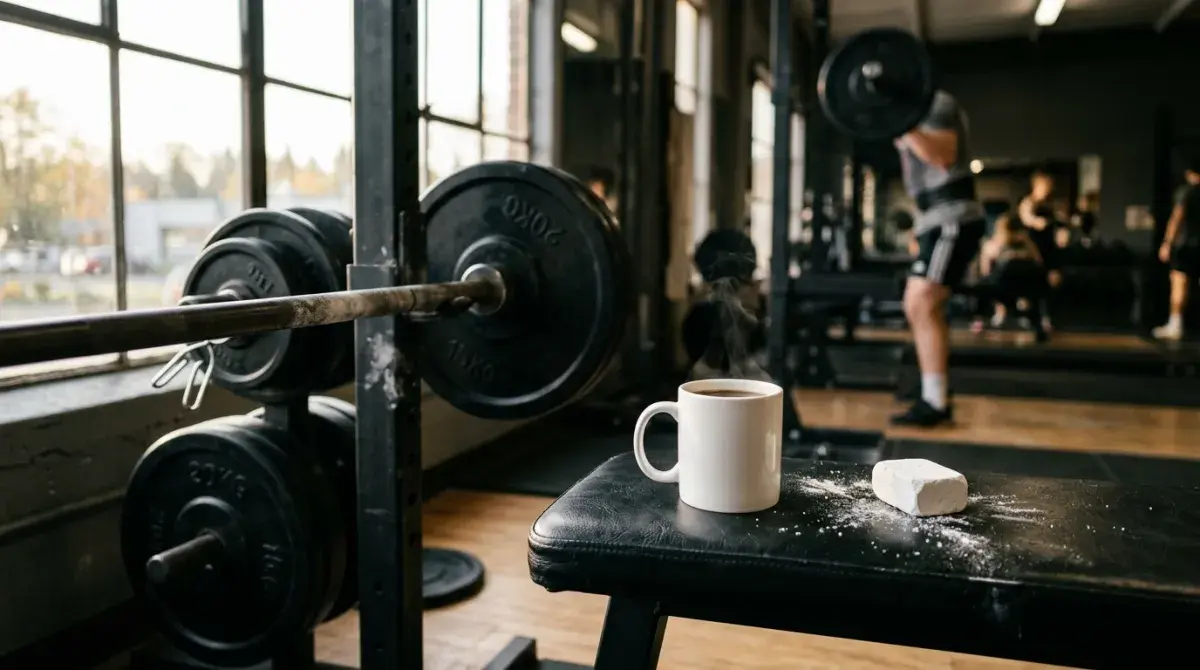
Caffeine is the most studied performance-enhancing substance on Earth, and one of the few that is unambiguously legal, cheap, and effective. The interesting question for lifters is not whether it works — it does — but how much, when to take it, and whether you lose the effect by drinking coffee every morning. Here is what the meta-analyses and the ISSN position stand actually say.
The Headline Number — How Much Caffeine Helps Strength
The cleanest meta-analysis on caffeine and strength is Grgic, Trexler, Lazinica, and Pedisic 2018 in the Journal of the International Society of Sports Nutrition (PMID 29527137). Pooling 10 controlled trials, the authors found a small but reliable improvement in 1-rep max strength after caffeine ingestion (standardized mean difference ~0.20). The effect was most consistent in upper-body lifts and at doses of 3-6 mg/kg.
Translated to absolute weight: a lifter benching 100 kg might add 1-3 kg to their 1RM under acute caffeine compared to placebo. That is small per session, but over a training block, the cumulative volume difference becomes meaningful — and the perception of effort drops, which makes hard sessions easier to start and finish.
Dose chart by bodyweight
| Bodyweight | Low dose (3 mg/kg) | Standard (4-5 mg/kg) | High (6 mg/kg) |
|---|---|---|---|
| 55 kg / 121 lb | 165 mg | 220-275 mg | 330 mg |
| 65 kg / 143 lb | 195 mg | 260-325 mg | 390 mg |
| 75 kg / 165 lb | 225 mg | 300-375 mg | 450 mg |
| 85 kg / 187 lb | 255 mg | 340-425 mg | 510 mg |
| 95 kg / 209 lb | 285 mg | 380-475 mg | 570 mg |
For reference: a brewed 8 oz coffee contains roughly 95-150 mg caffeine, an espresso shot ~65 mg, and a typical pre-workout scoop 150-300 mg. Energy drinks vary wildly — read labels.
The ISSN Position Stand — What Sports Scientists Officially Recommend
The International Society of Sports Nutrition position stand on caffeine and exercise performance (Guest et al. 2021, Journal of the International Society of Sports Nutrition, PMID 33388079) is the most authoritative summary in the field. Key consensus points:
- Effective dose: 3-6 mg/kg bodyweight, ingested 60 minutes before exercise.
- Higher doses (>9 mg/kg) do not produce more benefit and increase side effects (anxiety, GI upset, sleep disruption).
- Anhydrous caffeine (capsules, powder) is more reliably ergogenic than coffee — the absorption rate and total dose are easier to control.
- The effect is independent of habitual intake in most users — daily coffee drinkers still benefit from a pre-workout dose, though the magnitude may be slightly attenuated.
- Caffeine improves muscular endurance more reliably than maximal strength. The strength benefit is real but smaller than the endurance benefit.
Timing — Why 30-60 Minutes Before
Plasma caffeine concentration peaks roughly 30-60 minutes after oral ingestion, with significant individual variation. The Pickering and Kiely 2018 review in Sports Medicine (PMID 29541964) covered the genetic factors — the CYP1A2 gene polymorphism creates “fast” and “slow” caffeine metabolizers, and slow metabolizers may benefit from earlier dosing or smaller amounts to avoid lingering effects.
For a typical lifter without a known polymorphism, the practical timing is:
| Time before training | Effect on session |
|---|---|
| 0-15 min | Too early — minimal absorption when warmups start |
| 30-45 min | Sweet spot for capsule/powder forms |
| 45-60 min | Sweet spot for coffee (slower absorption with food) |
| 90+ min | Past peak — diminishing benefit |
The Tolerance Question — Daily Coffee vs Pre-Workout
The most contested claim in the gym-rat literature is whether daily caffeine kills the ergogenic effect. The cleanest answer comes from Beaumont, Cordery, Funnell, Mears, James, and Watson 2017 in the Journal of Sports Sciences (PMID 27892832), which had subjects consume a daily 3 mg/kg caffeine dose for 28 days. Time-trial performance improved at baseline, attenuated somewhat over the four weeks — but never returned to placebo level.
The Wilk, Krzysztofik, Filip, Zajac, and Del Coso 2019 strength-specific study (PMID 31268780) compared habitual caffeine users (>300 mg/day for >1 month) to non-users on the bench press. Both groups showed acute strength gains from a 6 mg/kg pre-workout dose; non-users gained slightly more, but the difference was modest.
Practical takeaway: daily coffee drinkers still benefit from pre-workout caffeine. If you want to maximize the effect for a meet or a key training day, a 7-14 day caffeine taper is supported by some weak evidence, but the magnitude of the gain is small — and the daily life cost of being caffeine-free is not.
Coffee vs Anhydrous Caffeine — Does the Form Matter?
The Hodgson, Randell, and Jeukendrup 2013 study in PLoS ONE (PMID 23573201) directly compared coffee to caffeine capsules at matched doses (5 mg/kg) before cycling time trials. Both improved performance similarly versus placebo, with no statistical difference between coffee and capsules.
For most lifters, coffee is fine. The reasons to prefer capsules or powder are: precise dose control (especially at the 3-4 mg/kg low end), no GI bulk, and no thermal/hydration considerations. If you train fasted in the morning, espresso or a 200 mg capsule lands more cleanly than 16 oz of brewed coffee.
Side Effects to Watch For
- Sleep disruption. Caffeine half-life is 5-7 hours, so a 5 PM dose still has 25-50% of its peak concentration at 11 PM. If you train evenings, cap the dose at 100-150 mg total or skip pre-workout caffeine entirely.
- Anxiety and tremor. Slow metabolizers and individuals with anxiety disorders often respond poorly to doses above 4 mg/kg. If you feel jittery, drop the dose 25-30%.
- Elevated resting heart rate. Acute heart rate increases of 5-15 BPM are normal. If you use a chest strap and HR-zone training, expect to drift higher in Zone 2 cardio sessions for the first 30-60 minutes after dosing.
- GI distress. Coffee on an empty stomach causes acid reflux and loose stools in some users. Capsules with a small carb snack work better.
- Dehydration is overstated. Caffeine is a mild diuretic, but at exercise-relevant doses the fluid loss is offset by the fluid in the coffee itself. Maddison, Iverson, and Rosing 2014 confirmed no meaningful hydration deficit at 3-6 mg/kg.
Caffeine and Sleep — the Single Biggest Trade-off
The largest practical downside of habitual caffeine is sleep degradation. Drake, Roehrs, Shambroom, and Roth 2013 in the Journal of Clinical Sleep Medicine (PMID 24235903) showed 400 mg of caffeine consumed 6 hours before bed reduced total sleep time by ~1 hour. Given the impact of sleep loss on muscle protein synthesis covered in our sleep and muscle growth article, that is a meaningful exchange — gaining a small per-session strength bump while losing a night of recovery is a bad trade.
The cleanest rule: no caffeine within 8-10 hours of bedtime. If you train at 6 PM, a pre-workout dose at 5 PM is fine only if you sleep at 1 AM or later. Most evening lifters are better off with placebo, ritual, and intra-workout carbs than caffeine.
How Caffeine Pairs With the Rest of Your Stack
Caffeine plays well with creatine — the Trexler et al. 2016 review in the Journal of the International Society of Sports Nutrition showed no meaningful interference, contrary to older small studies. See our creatine timing article for the dosing details. Caffeine pre-workout and creatine daily are both supported, independent stacks.
Caffeine and beta-alanine are often combined in pre-workouts. Beta-alanine has its own ~10-12 week loading curve and acts on muscle endurance, not nervous system arousal — different mechanism, additive effect. Citrulline malate, also common in pre-workouts, has a smaller and less consistent evidence base.
The Practical Protocol
- Find your bodyweight band on the dose chart above and pick the 3-4 mg/kg low end first.
- Ingest 30-60 minutes before lifting. Capsule or coffee — both work.
- Keep total daily caffeine under 400 mg (FDA daily safety guidance for healthy adults).
- No caffeine within 8-10 hours of bedtime. Sleep is more anabolic than caffeine.
- For a meet or a peak day, optionally taper for 7-10 days beforehand. Skip this for normal training — the gain is too small to justify the daily-life friction.
Where Calories and Macros Fit In
Caffeine sharpens performance per session; calories and protein build the actual results. Set your daily energy target with the TDEE calculator, lock in your protein floor with the protein calculator, and use the macros guide for ratios. A pre-workout dose has no benefit if your calorie or protein floor is below maintenance. If grocery costs are pushing your protein down, the paycheck calculator at pay.thicket.sh can help you find the budget line for a higher protein target.
The Bottom Line
At 3-6 mg/kg of bodyweight, taken 30-60 minutes before training, caffeine reliably improves strength performance — small in magnitude, but cheap, safe, and consistent. Daily coffee drinkers still benefit, just less. Coffee and capsules are roughly equivalent in effect at matched doses. The real trade-off is sleep: any caffeine in the second half of your day risks more recovery loss than performance gain. Lock in the dose, time it 60 minutes before lifting, and treat it as a session-level tool — not a training-block driver.
For broader pre-workout fueling, see the ACSM physical activity guidelines, then plug your numbers into the TDEE calculator.
Pre-Workout and Recovery Picks
We are deliberately not recommending caffeine pills or pre-workout powders here — single-ingredient supplements stacked into proprietary blends are a YMYL minefield, and the dose math in the article above lets you titrate caffeine more precisely from real coffee. The picks below are the coffee and protein products our reviewers ranked highest for actually executing the protocol.
Best Pre-Lift Coffee and Protein
Death Wish Coffee — Dark Roast Ground (16 oz)
About 472 mg caffeine per 12 oz brewed cup — roughly 2x typical drip. One cup 60 minutes pre-lift gets a 75 kg lifter into the lower end of the 3-6 mg/kg ergogenic range with a single mug.
★★★★★Optimum Nutrition Gold Standard 100% Whey
Caffeine sharpens performance per session — protein builds the result. ON Gold Standard delivers 24 g per scoop at the lowest cost-per-gram of any third-party-tested whey, the foundation a pre-workout sits on.
★★★★★Dymatize ISO100 Hydrolyzed Whey Isolate
Hydrolyzed for fastest absorption with 2.6 g leucine per scoop. The post-workout pairing for a caffeinated training session — the combined stimulus and protein synthesis trigger.
★★★★★We may earn a commission if you purchase through these links. This does not affect our recommendations.
As an Amazon Associate, we earn from qualifying purchases. Prices shown are typical — check Amazon for current pricing.
Time the cup 60 minutes before your warm-up, hit your protein floor with the protein calculator, and the rest is just consistency.
Frequently Asked Questions
Build the Calorie and Protein Foundation Caffeine Sits On
Caffeine sharpens output per session. Calories and protein build the actual gains. Set both with our calculators.