Body Recomposition Calculator vs TDEE Calculator: Which Numbers to Use (2026)
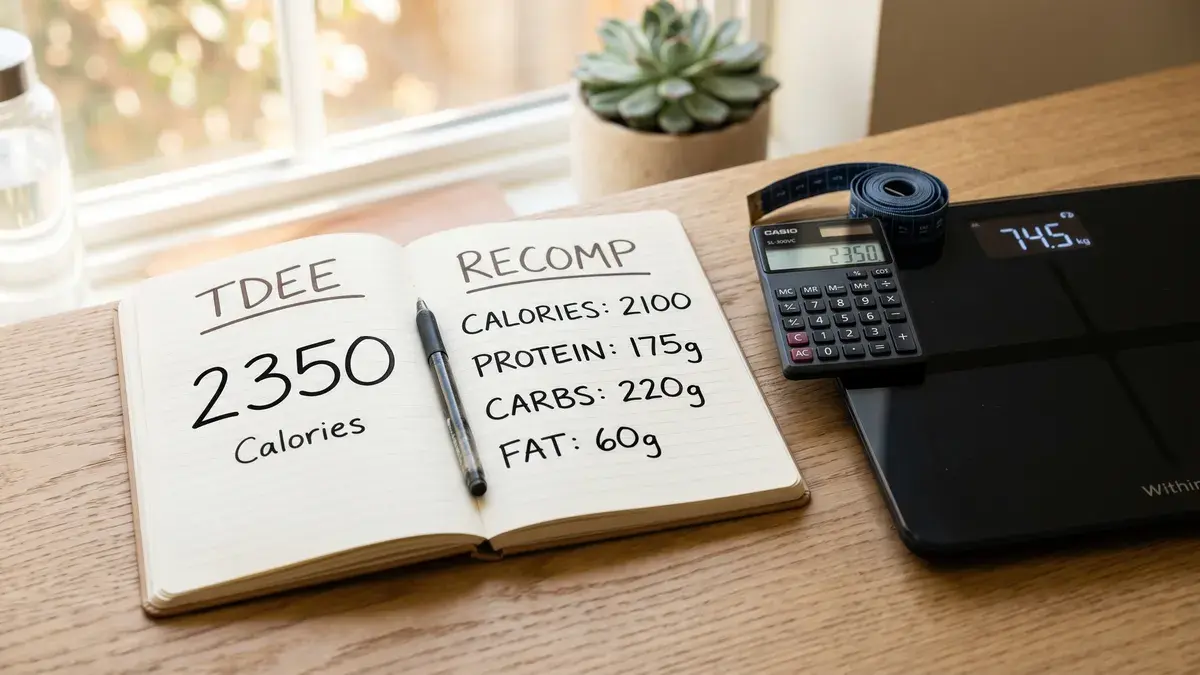
The single most common mistake people make when planning a recomp is mixing up two different numbers: their maintenance calories and their recomp target. They run a TDEE tool, get a number like 2,600 kcal, and start eating exactly that — then wonder why, twelve weeks later, the mirror looks identical. The problem is not effort. It is that they used a maintenance number where they needed a protocol. A TDEE calculator answers one question; a body recomposition calculator answers a different one. This article explains exactly how the two connect, which to run first, and how to avoid the garbage-in error that quietly wrecks most recomp attempts.
The Two Calculators Solve Different Problems
A TDEE calculator estimates your Total Daily Energy Expenditure: the total calories you burn in a day, accounting for your basal metabolic rate plus activity. It outputs a single number. That number describes a steady state — eat that many calories and your weight holds. Nothing about it tells you how to change your body composition; it only tells you the line you are currently standing on.
A body recomposition calculator takes that TDEE number as raw material and builds a protocol on top of it. It subtracts a small deficit, sets a protein target against your lean mass, and divides the remaining calories between carbs and fat. The output is not one number but four: a recomp calorie target, protein, carbs, and fat. Where the TDEE tool describes where you are, the body recomposition calculator describes where to aim.
| Question | TDEE calculator | Body recomp calculator |
|---|---|---|
| What it answers | How many calories do I burn? | What do I eat to recomp? |
| Inputs needed | Weight, height, age, sex, activity | TDEE, body fat %, training age, sessions/week |
| Output | One number (maintenance kcal) | Calorie target + protein + carbs + fat |
| When you run it | First | Second, using the TDEE output |
Why TDEE Is the Anchor (and Where It Comes From)
Total daily energy expenditure has four components: basal metabolic rate (~60-70% of the total), the thermic effect of food (~10%), exercise activity, and non-exercise activity thermogenesis (NEAT). The standard estimate multiplies a BMR formula — usually Mifflin-St Jeor — by an activity multiplier. Mifflin-St Jeor itself was validated against indirect calorimetry in the original 1990 derivation (Mifflin et al., PMID 2305711) and remains the most accurate general-population BMR equation in subsequent comparisons.
The catch is that the formula is a population average. NEAT alone varies enormously between individuals — Levine's classic overfeeding work showed NEAT differences of up to ~2,000 kcal/day between people eating the same surplus (Levine et al., PMID 9880251). That is why a formula TDEE should be treated as a hypothesis to test, not a fact. Run the numbers through a TDEE calculator to get your starting estimate, then verify it against two weeks of real bodyweight data before you trust it.
How the TDEE Number Flows Into the Recomp Math
Once you have a maintenance number, the body recomposition calculator applies a sequence the research supports. The deficit comes first. Helms, Aragon, and Fitschen's review of nutrition for natural physique athletes (PMID 24092765) recommended losses of 0.5-1% of bodyweight per week to retain lean mass — recomp lives at the gentle end, typically a 10-15% trim from TDEE. So a 2,600 kcal TDEE becomes roughly a 2,210-2,340 kcal recomp target.
Protein comes next, and here the recomp calculator needs a number the TDEE tool never asked for: body fat percentage. The protein target is set against lean body mass, not total weight, usually 2.2-2.6 g/kg of lean mass during a deficit. Barakat and colleagues' 2020 review of body recomposition (PMID 33555822) consolidated the evidence that simultaneous fat loss and muscle gain is achievable specifically when protein is elevated and resistance training is progressive — the two non-negotiables the calculator encodes. Carbs and fat split the remainder, with fat held at a 0.5-1.0 g/kg floor for hormonal health.
The Garbage-In Problem: Why a Bad TDEE Wrecks Everything Downstream
Because the recomp protocol is built entirely on the TDEE anchor, every error in the maintenance estimate propagates into every output. Suppose your true maintenance is 2,300 kcal but a formula overestimated it at 2,600. You apply a 12% recomp deficit and land at 2,290 — which is your actual maintenance. You eat there for three months, hit your protein, train hard, and recomp nothing, because you were never in a deficit at all. The math was perfect; the input was wrong.
This is why calibration matters more than tool choice. The procedure: log your real intake honestly for 10-14 days, track your morning bodyweight as a 7-day rolling average, and watch the trend. Stable weight means your logged average is your real TDEE — use that number, not the formula. The full calibration walkthrough lives in how to calculate your TDEE, and the accuracy ceiling of online estimates is quantified in how accurate TDEE calculators actually are.
The Second Input the Recomp Calculator Needs: Body Fat
A TDEE calculator can run on weight, height, age, and sex. A body recomposition calculator additionally needs body fat percentage, because lean mass is the denominator for the protein target. A 70 kg lifter at 18% body fat carries 57.4 kg of lean mass; at 2.4 g/kg lean, that is 138 g of protein. Report 13% body fat by mistake and the lean-mass figure jumps to 60.9 kg and the target to 146 g — an 8 g/day error that compounds across a 12-week block.
The accuracy of body fat methods varies. DEXA is the practical gold standard but costs money; the Navy tape method gets within roughly ±3% for trained users (Hodgdon & Beckett, Naval Health Research Center, 1984); smart scales using bioelectrical impedance are noisier in absolute terms but consistent enough to track change if used the same way each time. Consistency of method beats absolute accuracy here — pick one and reuse it. For the broader picture of which composition metric to track, see lean body mass vs body fat percentage.
A Worked Example: Same Person, Both Calculators
Take a 78 kg male, 175 cm, 30 years old, 17% body fat, training 4 days a week with a desk job. Step one, the TDEE calculator: Mifflin-St Jeor BMR is about 1,720 kcal; a "lightly active" multiplier of 1.45 gives a TDEE estimate near 2,490 kcal. He logs intake for two weeks, holds weight at 2,520 kcal, and adopts 2,520 as his calibrated maintenance.
Step two, the body recomposition calculator, using the calibrated 2,520: a 12% recomp deficit sets calories at ~2,220. Lean mass is 64.7 kg, so protein at 2.4 g/kg lands at ~155 g (620 kcal). Fat at 0.8 g/kg of bodyweight is ~62 g (560 kcal). The remaining 1,040 kcal goes to carbs — ~260 g. Final targets: 2,220 kcal, 155 g protein, 260 g carbs, 62 g fat. The TDEE number was a single value; the recomp calculator turned it into a daily plan.
When the Two Numbers Should Be the Same
For most lifters the recomp target sits below TDEE. But there is one population where the two numbers converge: advanced lifters under about 12% body fat (men) or 20% (women). At that leanness the body resists further fat loss and a deficit starts costing muscle, so the recomp target rises to maintenance or a slight surplus — functionally a slow lean bulk with a strict body-fat ceiling. The Iraki review on off-season natural bodybuilding (PMID 31247944) makes this case explicitly. The experience-level breakdown of where the deficit shrinks to zero is mapped in recomp calorie and macro targets by experience level.
Recalibration: Both Numbers Move Over Time
Neither number is static. After 8-12 weeks in a deficit, resting metabolic rate adapts downward 5-10% as the body defends against energy loss, so your real TDEE drifts below the original estimate. At the same time, if body fat has dropped, your lean-mass figure changes and the recomp calculator's protein target shifts. The practical loop: every two weeks, check your 7-day weight trend; if fat loss has stalled, your TDEE has fallen and you trim the recomp target by 100-150 kcal. Every 4-8 weeks, re-measure body fat and rerun the body recomposition calculator with the new lean-mass number. The detailed timeline math is in body recomposition math and real timelines.
Budgeting the Recomp Diet Against Real Take-Home
A 150-160 g/day protein target is more expensive to hit than a carb-heavy diet — expect a 20-30% higher grocery line from the extra chicken, fish, eggs, dairy, and whey. Before you commit to a number, it is worth confirming the monthly food spend fits your actual take-home rather than your gross salary. The paycheck calculator at PayScale Pro back-solves a sustainable monthly food budget from your net pay, which is the figure that actually constrains the recomp diet you can hold for three months.
The Bottom Line
A TDEE calculator and a body recomposition calculator are not competitors — they are sequential. The TDEE tool gives you one number, your maintenance calories, and that number is only trustworthy after a two-week calibration against real bodyweight data. The body recomposition calculator then takes that anchor, subtracts a 10-15% deficit, sets protein against lean mass, and splits the rest into carbs and fat. Get the TDEE input right, feed it an accurate body fat number, and the recomp targets follow. Get the TDEE wrong, and the cleanest recomp math in the world produces nothing.
Run the maintenance estimate through the TDEE calculator, calibrate it for two weeks, then plug the calibrated number into the body recomposition calculator to get your daily targets. Cross-check the protein distribution in the macro calculator, hold the numbers for eight weeks, and recalibrate.
Frequently Asked Questions
Turn Your TDEE Into Recomp Targets
Calibrate your maintenance number, then run the CalcFit body recomposition calculator for personalized calorie and macro targets.