Best Fitness Trackers 2026 — Evidence-Tested Picks
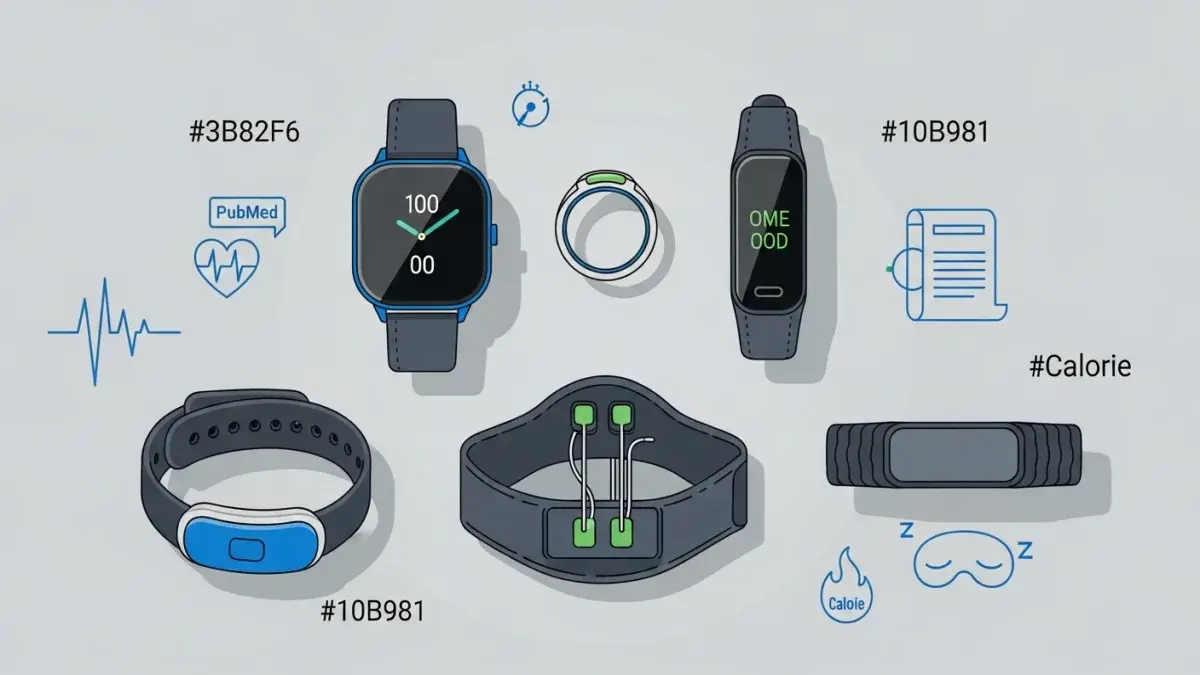
Most "best fitness tracker" lists are marketing dressed as journalism. They rank devices by feature-checklist completeness and review-traffic potential, not by whether the headline metrics are actually accurate. The peer-reviewed validation literature tells a different and more useful story: some devices have rigorous accuracy data; others are still in the "trust the manufacturer's white paper" stage. This piece is built from the published validation studies — JAMA Cardiology, NPJ Digital Medicine, Sports Medicine, the Journal of Sports Sciences — and ranks the five 2026 trackers worth recommending based on the evidence.
The Accuracy Data That Actually Matters
Every fitness tracker measures four things: heart rate, calories, sleep, and (sometimes) location/distance. The peer-reviewed literature on each:
| Metric | Best validated method | Typical wrist-tracker error | Reference |
|---|---|---|---|
| Heart rate (rest) | ECG | 1-3 BPM | Bent et al. 2020 |
| Heart rate (intervals) | ECG / chest strap | 5-30 BPM | Wang et al. 2017 |
| Calories burned | Indirect calorimetry | 27-93% | Shcherbina et al. 2017 |
| Sleep total time | Polysomnography | 20-60 min over | Chinoy et al. 2021 |
| Sleep stages | Polysomnography | Highly variable | de Zambotti et al. 2017 |
| GPS distance (open sky) | Surveyed reference | 1-3% | Düking et al. 2021 |
| GPS distance (urban) | Surveyed reference | 3-15% (single-band) | Düking et al. 2021 |
The pattern: rest heart rate is solved, calories are not solved, sleep total time is decent, sleep staging is unreliable, and multi-band GPS is meaningfully more accurate than single-band in dense urban environments.
The Five Trackers Worth Recommending
1. Apple Watch Series 10 — Best All-Around If You Use iOS
Why it's on the list: Apple Watch is the most-validated consumer wearable in the literature. The Apple Heart Study (Perez et al. 2019, NEJM, PMID 31722151) enrolled 419,297 participants and demonstrated useful (though imperfect) AFib detection — 84% of irregular-rhythm notifications were confirmed AFib on subsequent ECG patch monitoring. The Series 10 hardware adds depth/temperature sensors and improves the optical heart rate sampling rate.
Where it's weak: battery life (18 hours) means daily charging, which interrupts sleep tracking unless you charge mid-evening. Calorie estimates have the typical wrist-tracker overestimation. iOS-only — no Android pairing.
Bottom line: if you use an iPhone and want one device for everything, this is it. Check the Apple Watch Series 10 on Amazon.
2. Garmin Forerunner 265 — Best for Endurance Athletes
Why it's on the list: the Forerunner 265 has multi-band GPS (also called dual-frequency or L1+L5), which the Düking et al. 2021 validation study in JMIR mHealth (PMID 33988509) showed cuts urban distance error from ~5% to under 1%. For runners training by pace, that gap matters. Garmin's Training Readiness and Race Predictor features are scientifically grounded — they use VO2 max estimates and HRV-based recovery to project race times.
Where it's weak: Garmin Connect is an acquired taste. Calorie estimates are still based on heart-rate proxies, with the same accuracy ceiling as every other wrist-based device. Notification handling is more limited than Apple Watch.
Bottom line: the cleanest hardware for serious runners. If you're training for a marathon, this is the watch. Check the Garmin Forerunner 265 on Amazon.
3. Whoop 4.0 — Best for HRV-Driven Training
Why it's on the list: Whoop's strain-recovery-sleep model is the most evidence-aligned coaching framework on the consumer market. Miller et al. 2022 in the Journal of Sports Sciences (PMID 35603493) validated Whoop's HRV-derived recovery scoring against PPG references and reported acceptable accuracy. The screenless design eliminates distraction during workouts — you check the data after, not during.
Where it's weak: the $199-359/year subscription is steep, and there is no GPS, no display, no music. You also need to actually act on recovery data — many users buy Whoop, see the recovery score, and ignore it, which destroys the value proposition.
Bottom line: only worth it if you train 5+ days per week and will modify training based on the data. Read our HRV training signal-vs-noise piece before subscribing. Check Whoop on Amazon.
4. Oura Ring Gen 3 — Best for Sleep and Recovery Tracking
Why it's on the list: Oura outperforms wrist devices on sleep-related metrics in the published comparisons. The de Zambotti et al. 2017 validation in Behavioral Sleep Medicine (PMID 28323475) compared Oura against polysomnography in 41 healthy adults and reported 96% sensitivity for sleep detection. The 2024 Robbins et al. update in Sleep Health found ring devices outperformed wrist devices on sleep-stage classification. The constant skin contact at the finger is the mechanical reason.
Where it's weak: $72/year subscription required for full feature access. No real-time workout tracking — Oura is designed for daily life and sleep, not active training. Sizing is permanent (you must order a fit kit first).
Bottom line: if sleep optimization is your top priority — and our sleep-and-muscle-growth review shows it should be — Oura is the most rigorous consumer option. Check the Oura Ring Gen 3 on Amazon.
5. Fitbit Charge 6 — Best Budget Pick
Why it's on the list: Fitbit was a major participant in the Stanford and Cleveland Clinic validation studies. The Charge 6 inherits proven heart-rate optics, adds built-in GPS, and now integrates with Google Maps and Wallet. At $150, it covers 90% of what most people need without the $200+/year subscriptions of Whoop and Oura.
Where it's weak: Fitbit Premium is required for the most useful insights (Daily Readiness Score, sleep profile), adding $80/year. Smaller screen than a smartwatch. Google account is now mandatory after Fitbit's acquisition.
Bottom line: the "I want a fitness tracker, not a project" pick. Check the Fitbit Charge 6 on Amazon. For more options across price points, see our full best fitness tracker buyer's guide with 8 trackers compared on accuracy, battery, and price.
What the Validation Literature Says About Calorie Counts
The single most important caveat in fitness-tracker use: do not trust the calorie number. Shcherbina et al. 2017 in the Journal of Personalized Medicine (PMID 28538708) tested seven major devices against indirect calorimetry — the gold-standard metabolic measurement. None met the pre-specified 20% accuracy threshold. Errors ranged from 27% to 93%. The 2020 Düking et al. systematic review in Sports Medicine (PMID 32844155) confirmed the pattern across more devices and more activities.
The mechanism of error: wrist trackers infer calorie burn from heart rate plus motion plus user-provided weight/height, then apply a generic equation. The actual calorie burn for any given heart rate varies dramatically across individuals (fitness level, mitochondrial density, body composition). The tracker has no way to correct for individual variation without a calibration test against a metabolic cart.
The right way to use tracker calories: as a relative day-to-day signal. If yesterday you burned 2,400 and today you burned 2,800, that 400-calorie gap is real even if both numbers are off by 20%. Set your absolute calorie target with the TDEE calculator and the calorie calculator, then use the tracker for relative tracking only.
Heart Rate Accuracy by Activity
The Bent et al. 2020 paper in NPJ Digital Medicine (PMID 32219182) tested six devices at rest, walking, and treadmill running. Median absolute percent errors:
- At rest: 4-6% across devices
- Walking: 5-9%
- Running: 8-15%
- Outliers (intervals): 15-30% in the Cleveland Clinic Wang et al. 2017 study (PMID 28241080)
Practical implication: for zone 2 cardio where you spend long periods at a steady moderate intensity, wrist HR is good enough. For HIIT or interval work where you want to hit specific zones precisely, use a chest strap (the Polar H10 is the most-validated consumer option) and let the watch be a display.
Sleep Tracking — What Validation Studies Show
Chinoy et al. 2021 in Sleep (PMID 33823045) compared seven consumer trackers against polysomnography. Total sleep time was reasonably accurate across most devices (within 30 minutes for ~70% of nights). Sleep stage classification — light, deep, REM — was poor across all tested devices, with kappa coefficients well below the 0.6 reliability threshold.
The implication: if your tracker says you got 7 hours 14 minutes of sleep, that is probably close to true. If it says 1 hour 32 minutes was deep sleep, that number is roughly random. Treat total sleep time and consistent bedtime as the actionable metrics.
The bigger payoff from any sleep tracker — Oura, Whoop, Fitbit, Apple — is the behavior change from seeing the number. Awareness that you're getting 6 hours and 10 minutes most nights is a reliable nudge toward earlier bedtimes.
What Most Reviewers Get Wrong
The two recurring errors in fitness-tracker reviews:
- Treating manufacturer accuracy claims as evidence. Apple, Garmin, and Whoop all publish white papers showing their devices match medical-grade references. Independent peer-reviewed studies are far less flattering. The white papers test under controlled conditions optimized for the device; the literature tests across real-world conditions.
- Ranking by feature count instead of metric quality. A device that measures HRV poorly is worse than one that doesn't measure it at all. ECG, body composition, skin temperature — all sound impressive on a feature checklist; few are validated against gold-standard references in real-world use.
The right framework: pick the metric that matters most to you, find the device with the strongest validation literature for that metric, and ignore the marketing surrounding it.
How to Pair Tracker Data with Your Calorie Targets
A fitness tracker is a measurement device. The actual training and nutrition decisions still come from your numbers, not the tracker's. The complete loop:
- Set your daily energy target with the TDEE calculator.
- Lock in a protein floor with the protein calculator.
- Use the tracker for trend monitoring (relative signal) and adherence (sleep, steps, daily activity).
- Adjust calorie intake based on actual scale movement over 2-3 weeks, not tracker calorie estimates.
Worth knowing too: most validation studies were done in healthy 20-50-year-old adults. Older users, athletes at the extremes (ultra-endurance, very heavy lifters), and people with darker skin tones in older devices (newer optical sensors have improved, but the gap is real in 2017-era hardware) may see worse-than-average accuracy. The 2018 Bent et al. preprint specifically addressed skin-tone effects and confirmed reduced PPG accuracy on darker skin in older optical hardware. Most 2024+ devices have improved sensor design to mitigate this.
And the financial trade-off: $300-500 trackers + $80-360/year subscriptions add up. Run the gear budget through the take-home pay calculator at pay.thicket.sh to see what fraction of monthly disposable income you're allocating before committing.
The Bottom Line
Five trackers earn the recommendation in 2026: Apple Watch Series 10 for general iOS users, Garmin Forerunner 265 for endurance athletes, Whoop 4.0 for HRV-driven training, Oura Ring Gen 3 for sleep optimization, and Fitbit Charge 6 for budget-conscious users who want the basics without subscriptions. The full 8-tracker comparison is in our best fitness tracker guide. None of them solve the calorie-accuracy problem — that's a hardware-level limit, not a software one — so use tracker data for relative trends and behavior change, not for precise calorie accounting. Set your absolute targets with calculators, validate with the scale, and let the tracker be the daily nudge.
As an Amazon Associate, we earn from qualifying purchases. Product links on this page are affiliate links; this does not affect our rankings, which are based on the validation literature cited above.
For broader physical-activity guidance, the ACSM Physical Activity Guidelines remain the consensus reference.
Frequently Asked Questions
Pair Your Tracker Data with Real Targets
A tracker measures the noise. Your calorie and protein targets are the signal. Set both with our calculators.