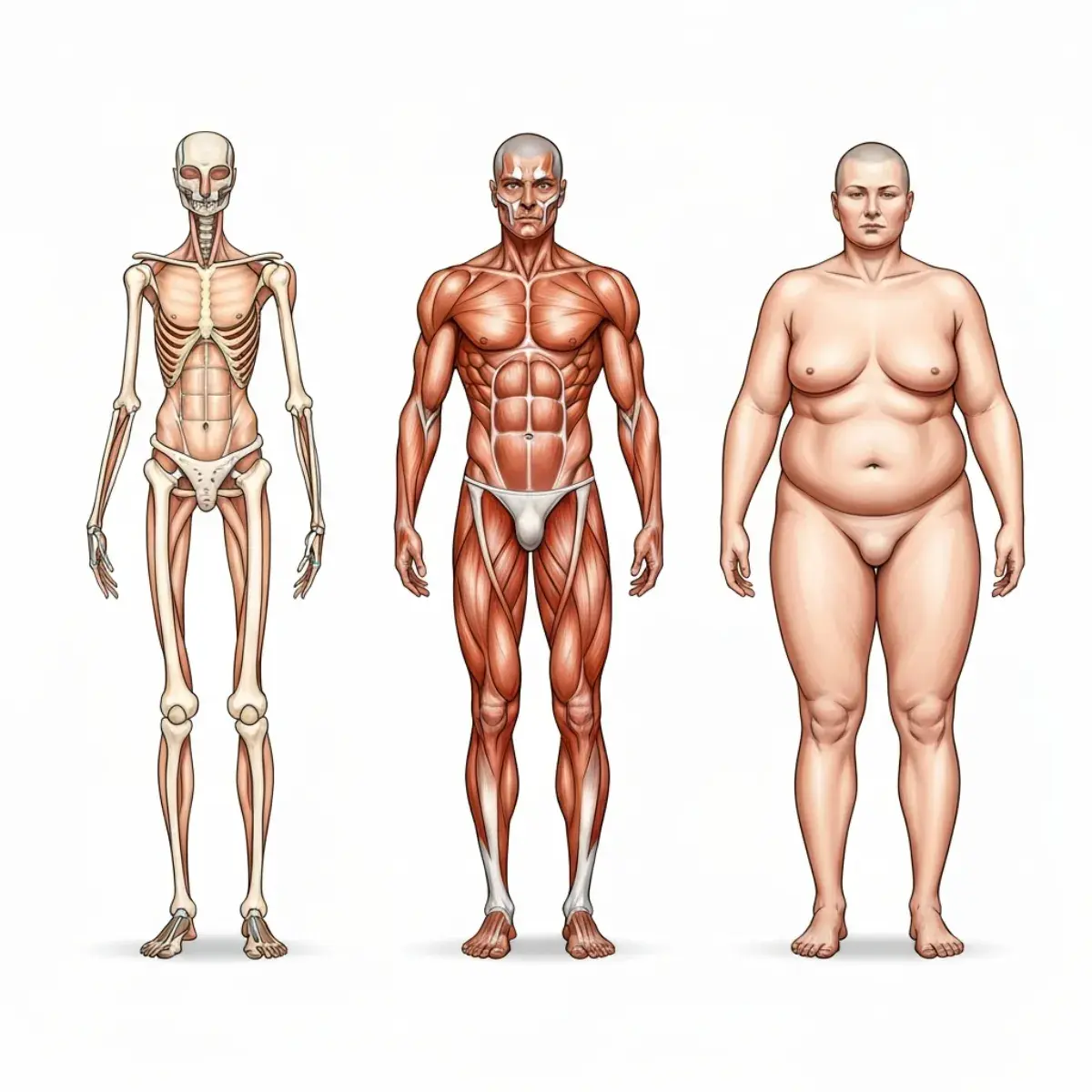
Find out if you're an ectomorph, mesomorph, or endomorph based on your frame size and proportions.
Frequently Asked Questions
The three somatotypes are ectomorph (lean, long-limbed, fast metabolism), mesomorph (naturally muscular, medium frame), and endomorph (broader, stores fat more easily). Most people are a blend of two types rather than purely one.
Wrist circumference is a reliable proxy for skeletal frame size because the wrist has very little fat or muscle. A smaller wrist relative to height suggests an ectomorphic (small-framed) build, while a larger wrist suggests an endomorphic (large-framed) build.
Your skeletal frame (bone structure) is genetic and cannot change. However, you can significantly alter your body composition through training and nutrition. An endomorph can become lean and an ectomorph can build substantial muscle — the body type just indicates your natural tendencies.
HWR is calculated as height in centimeters divided by the cube root of weight in kilograms. It was developed as part of the Heath-Carter somatotype system. An HWR above 40.75 suggests ectomorph, between 38.25-40.75 suggests mesomorph, and below 38.25 suggests endomorph.
Body type can inform your starting strategy but should not limit you. Ectomorphs may benefit from higher calories and compound lifts. Endomorphs often respond well to higher protein and regular cardio. Mesomorphs have flexibility but still need progressive overload. Ultimately, consistency matters more than body type.
Somatotypes are a useful starting point, but modern sports science treats them as tendencies, not destiny. Your training, nutrition, and consistency matter far more than your genetic frame.