Does Lifting Weights Stunt Growth?
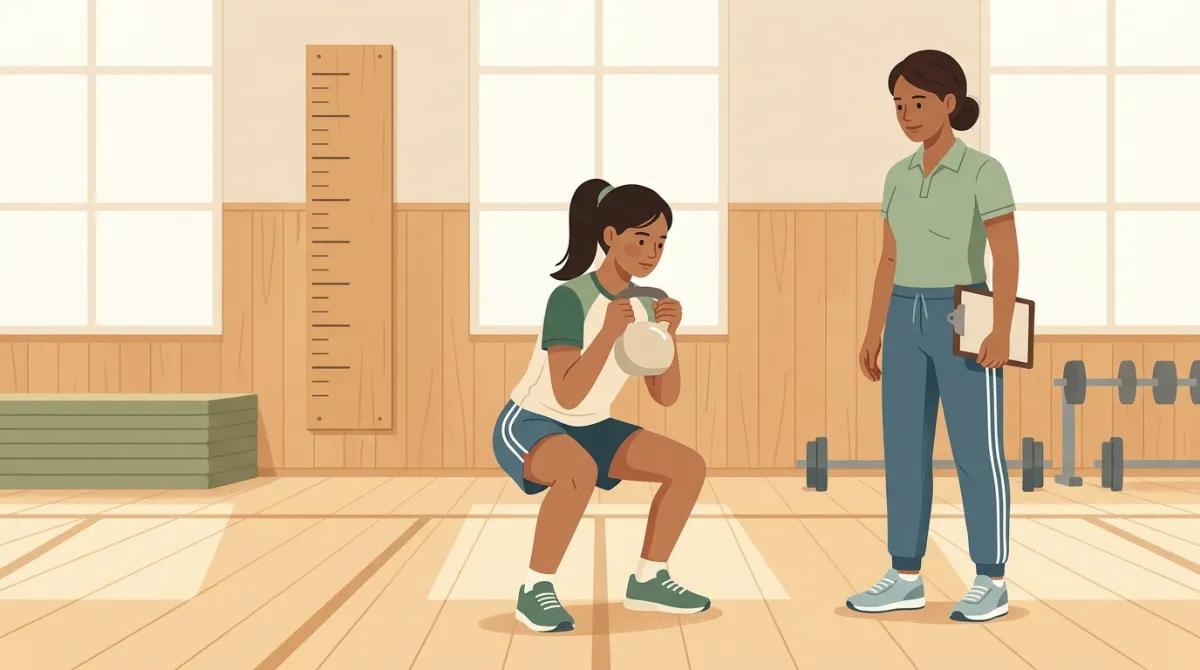
No, not in the studies that measured it. A review of 22 resistance training studies in children and young teens found the programmes did not affect growth in height or weight. The real risk is different: accidents, mostly dropped weights, when kids lift without supervision. Coaching and sensible loads deal with most of it.
Where the worry comes from
Children and teens have growth plates, also called physes. These are areas of cartilage near the ends of long bones where growth happens, and they are a weak point. A 2010 review by Faigenbaum and Myer in the British Journal of Sports Medicine notes that the growth plate can be three to five times weaker than the surrounding connective tissue, and may resist shear and tension forces less well.
So the fear makes sense on paper. If a heavy load damaged a growth plate, it could in principle affect how that bone grows. The question is whether training actually does that in practice.
What the training studies found
The most direct answer comes from Robert Malina’s 2006 evidence-based review in the Clinical Journal of Sport Medicine. He looked at 22 experimental resistance training studies in pre- and early-pubertal youth. Most used weight machines and free weights, two or three sessions a week, for 8 to 12 weeks.
| Question | What Malina (2006) found |
|---|---|
| Did kids get stronger? | Yes, significantly, in childhood and early adolescence |
| Did it affect growth? | No effect on growth in height or weight |
| Body composition? | Changes were variable and quite small |
| Injuries? | 3 injuries across the 10 studies that tracked them |
| Injury rate | 0.176, 0.053 and 0.055 per 100 participant-hours |
His conclusion was that supervised programmes with weights and machines, run with low instructor-to-participant ratios, are relatively safe and do not negatively affect growth and maturation. One more detail from the same review: strength gains were lost once training stopped, so the benefits depend on keeping it up.
The 2010 Faigenbaum and Myer review adds a specific point on growth plates. Injury to the growth cartilage had not been reported in any prospective youth resistance training study that provided professional guidance and instruction.
Where youth lifting injuries actually happen
Trials are supervised by design, so they cannot tell you what happens in a garage. Myer and colleagues filled that gap. They looked at 4,111 weightlifting injuries treated in US emergency rooms from 2002 to 2005, among people aged 8 to 30.
- Accidents fell with age. The 8 to 13 group had the highest share of accidental injuries, defined as dropped weights or improper use of equipment.
- Two thirds of injuries in 8 to 13 year olds were to the hands and feet, usually described as “dropping” or “pinching”. This group also had a higher share of fractures than any other age group.
- Sprains and strains rose with age. The authors concluded that children have a lower risk of these lifting injuries than adults.
The authors judged most youth injuries to be accidents that closer supervision and stricter safety rules could prevent. The growth plate case the 2010 review describes fits the pattern: a 13-year-old boy fractured the growth plates of both wrists when he lost control of a 30 kg barbell overhead, while training alone in a makeshift home gym.
The same review makes a point that puts this in proportion. The risk of growth plate injury may be greater in competitive sport, where jumping and landing can produce ground reaction forces of five to seven times body mass.
What the expert bodies say
The National Strength and Conditioning Association’s 2009 position statement says that many of the benefits of adult resistance training are attainable by children and adolescents who follow age-specific guidelines, and that qualified acceptance of youth resistance training by medical, fitness and sport organisations is becoming universal.
The American Academy of Pediatrics updated its own guidance in 2020, and an international consensus statement on youth resistance training was published in 2014. Both are listed below. The common thread in the reviews we read is the same condition: qualified supervision and age-appropriate instruction.
How to keep it safe
The steps below are our reading of the evidence above, not a finding of any one paper.
- Supervise every session. Every review here ties safety to qualified supervision. Unsupervised home lifting is where the accidents cluster.
- Teach technique before load. Start with bodyweight or very light weights and add load only when form holds up.
- Clear the floor and store weights properly. Hand and foot injuries from dropped and pinched equipment were the most common pattern in younger children.
- Do not press weights overhead alone. The documented growth plate case was a boy pressing a 30 kg barbell overhead with no one watching.
- Use a simple plan. Two or three sessions a week was the typical dose in the trials. Our guide to progressive overload covers how to add load gradually, and warm-up sets covers how to start each session.
What this evidence cannot tell you
The training studies Malina reviewed lasted weeks to months, so they show no effect on growth during a programme. They do not follow children to adult height. The emergency room data only capture injuries serious enough for a hospital visit and cannot give a rate per hour of training. And the position statements are expert consensus, not new trials. This summary rests on the published abstracts of the papers below, plus the full text of the 2010 review, and it cannot tell you what is right for a particular child.
Sources
- Malina RM. Weight training in youth-growth, maturation, and safety: an evidence-based review. Clin J Sport Med. 2006;16(6):478-87. PMID 17119361
- Faigenbaum AD, Myer GD. Resistance training among young athletes: safety, efficacy and injury prevention effects. Br J Sports Med. 2010;44(1):56-63. PMC3483033
- Myer GD, Quatman CE, Khoury J, Wall EJ, Hewett TE. Youth versus adult “weightlifting” injuries presenting to United States emergency rooms: accidental versus nonaccidental injury mechanisms. J Strength Cond Res. 2009;23(7):2054-60. PMC4034275
- Faigenbaum AD, Kraemer WJ, Blimkie CJ, et al. Youth resistance training: updated position statement paper from the National Strength and Conditioning Association. J Strength Cond Res. 2009;23(5 Suppl):S60-79. PMID 19620931
- Stricker PR, Faigenbaum AD, McCambridge TM; Council on Sports Medicine and Fitness. Resistance training for children and adolescents. Pediatrics. 2020;145(6):e20201011. PMID 32457216
- Lloyd RS, Faigenbaum AD, Stone MH, et al. Position statement on youth resistance training: the 2014 International Consensus. Br J Sports Med. 2014;48(7):498-505. PMID 24055781
General information, not medical advice. If your child has an injury, pain near a joint or a medical condition, check with their doctor before they start or continue training.
Related
- Progressive overload for beginners and intermediates
- Warm-up sets: how many do you need?
- Does stretching prevent injury?
- How many rest days per week?